The Paris Climate Agreement, which was adopted in 2015, is a key reference to calculate climate targets. In this agreement, many countries have committed to limiting global warming to well below 2 °C compared to the time before industrialization, while striving to limit global warming to 1.5 °C.
To achieve these goals, it can be of great help to define targets on a local level, highlighting the role of each country or even city in limiting emissions. This is precisely the goal of the CO₂ Budget assessment tool in the Climate Action Navigator: showing how much CO₂ a city has already emitted since the Paris Agreement and how much it is still allowed to emit before exceeding a certain climate warming target.
Some more context is useful to interpret these budgets: to better understand where we stand now, we first look at the emissions trend for several German cities in the last decades. Then we calculate the still remaining CO₂ budgets and estimate future trends.
Urban Emission Trends in Germany Since 1990
A longer-term perspective on CO₂ emissions reveals substantial progress in Germany. Germany’s total greenhouse gas emissions peaked in 1979 at 1.35 billion tonnes and declined to 660 million tonnes in 2024: a reduction of over 50 percent over 45 years.
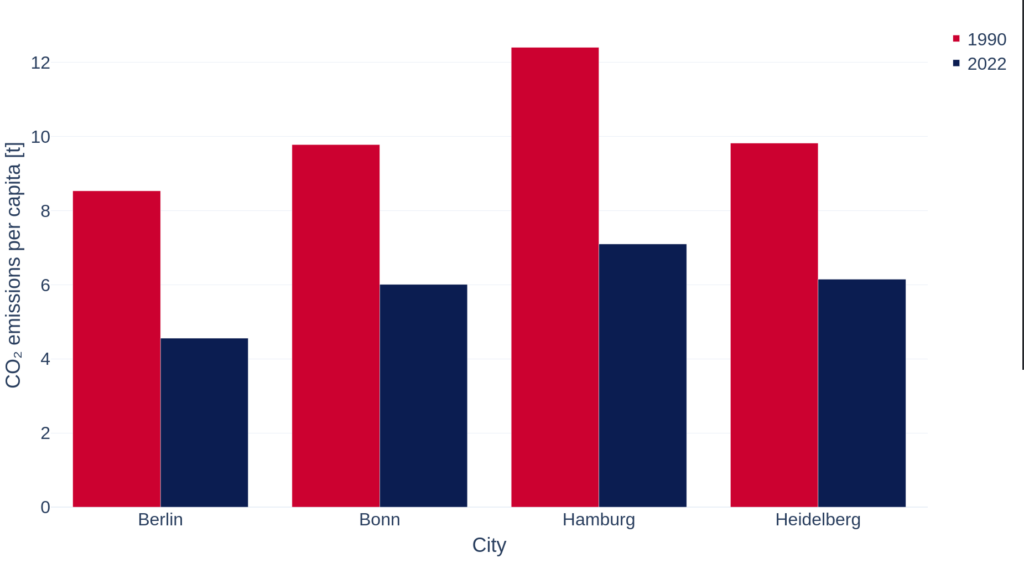
The same downward trend is visible at the urban level. Since 1990, emissions have decreased in all German cities for which the CO₂ Budget assessment tool provides data. In Hamburg, for instance, emissions declined from 12 tonnes per capita in 1990 to 7 tonnes per capita in 2022. Comparable reductions are observed in other cities we analyzed: Berlin, Bonn, and Heidelberg.
These figures demonstrate that structural emission reductions are achievable and have already been realized across multiple decades.
Remaining CO₂ Budgets: How much can our cities still emit?
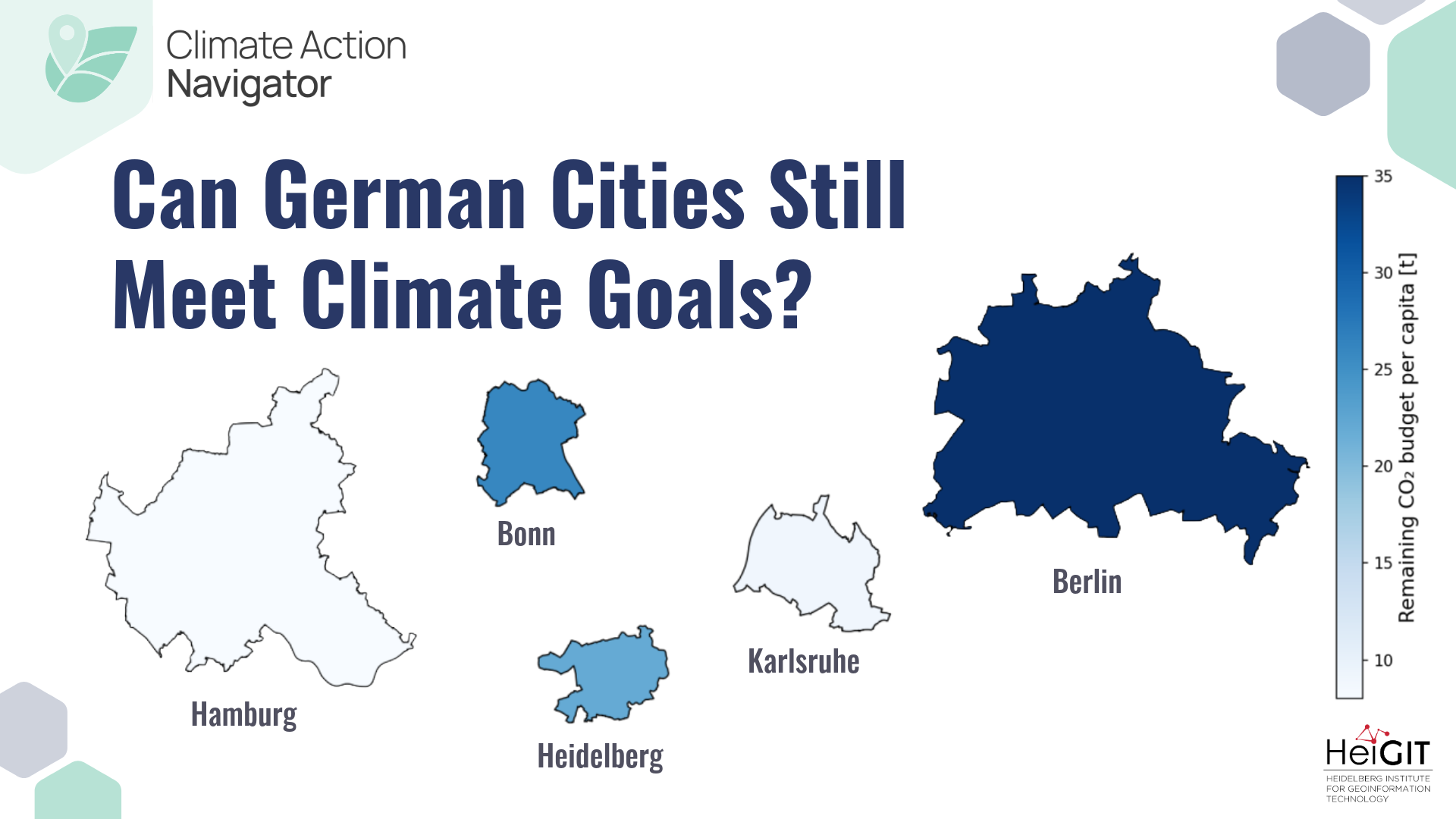
Despite historical reductions, the remaining CO₂ budgets are very limited. A CO₂ budget shows how much CO₂ a particular city can still emit while doing its part to limit global warming.
For example, Hamburg’s reported and projected emissions indicate that its emission budget to stay within 1.5 degree warming has already been exceeded, its 1.7 degree budget is nearly exhausted and that its 2 degree budget is also at risk if emission reductions do not accelerate.
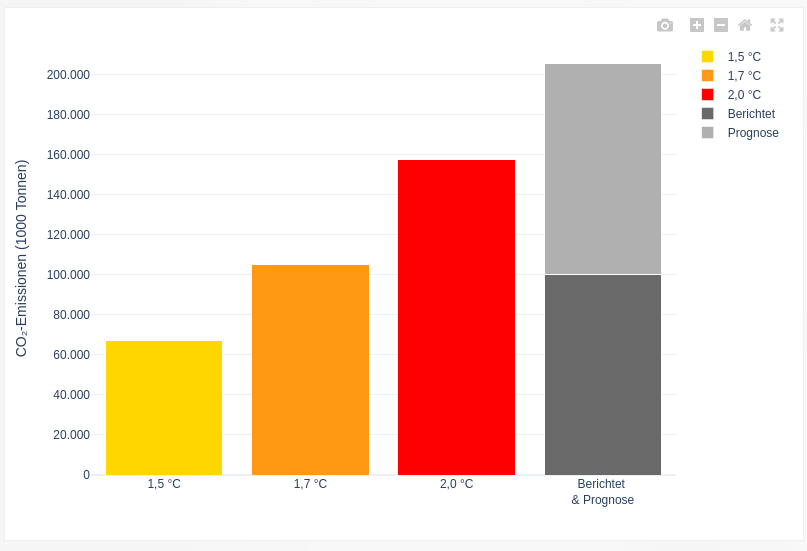
The grey bar in the figure above shows the reported and projected emissions of Hamburg, assuming that the city will follow a linear emission reduction path from now on to reach zero emissions in 2040. The reported emissions are dark grey and the projected emissions are light grey. It is clear that Hamburg has almost used up its CO₂ budget for the 1.7 °C target and will probably exceed the budget for 2 °C warming if no additional emission reduction measures are implemented.
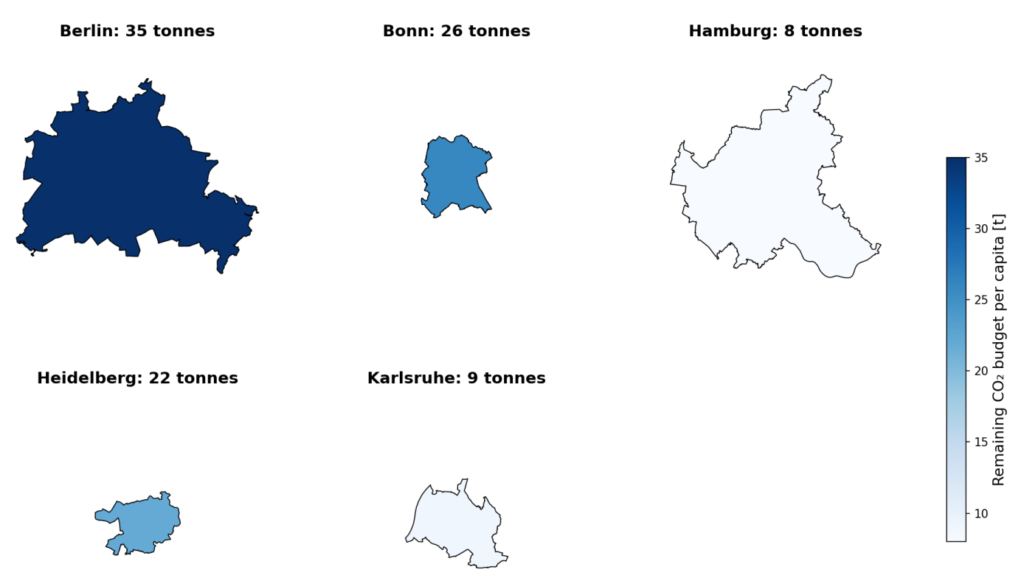
On the Climate Action Navigator, you can also estimate the remaining CO₂ budgets for several other German cities (Berlin, Bonn, Heidelberg, and Karlsruhe), and the results are often similar. All these cities have already exceeded their budget for limiting warming to 1.5 or 1.7 degrees Celsius or are projected to do so soon. Even compliance with the 2-degree target requires accelerated mitigation.
Where do we go from here?
Germany has already reduced its greenhouse gas emissions by half compared to their historical peak in 1979. All analyzed cities have significantly lowered emissions since 1990. These achievements are the result of technological advancements, policy intervention, and societal changes.
At the same time, the fact that most cities are close to consuming all their remaining CO₂ budgets shows that stronger climate action is urgently needed. To comply with the Paris Agreement goals, emission cuts must continue and, in many cases, accelerate.
The emissions reductions we already achieved demonstrate that transformative change is possible. The task now is to build on this progress and ensure that future emission trajectories align with the remaining carbon budget.
The Climate Action Navigator provides a data-driven basis to pinpoint emission reduction potential. Quantifying remaining CO₂ budgets and visualizing emission pathways supports transparent assessment and informed decision-making.