The ohsome-planet tool transforms OpenStreetMap (OSM) history PBF files into GIS-ready Parquet datasets. It reconstructs the actual geometries of OSM nodes, ways, and relations and enriches them with additional contextual information. For example, metadata from OSM changesets can be joined to each element, and country codes can be assigned by providing a boundary dataset as additional input. The resulting ohsome-planet data can be used for a wide range of geospatial analyses with tools such as DuckDB, GeoPandas, or QGIS.
ohsome-planet is build for people and organizations that want to work with the OSM data, but in a GIS-ready data format. Typical users include data analysts and researchers who explore OSM data in depth and combine it with other geospatial or non-spatial datasets for further analysis.
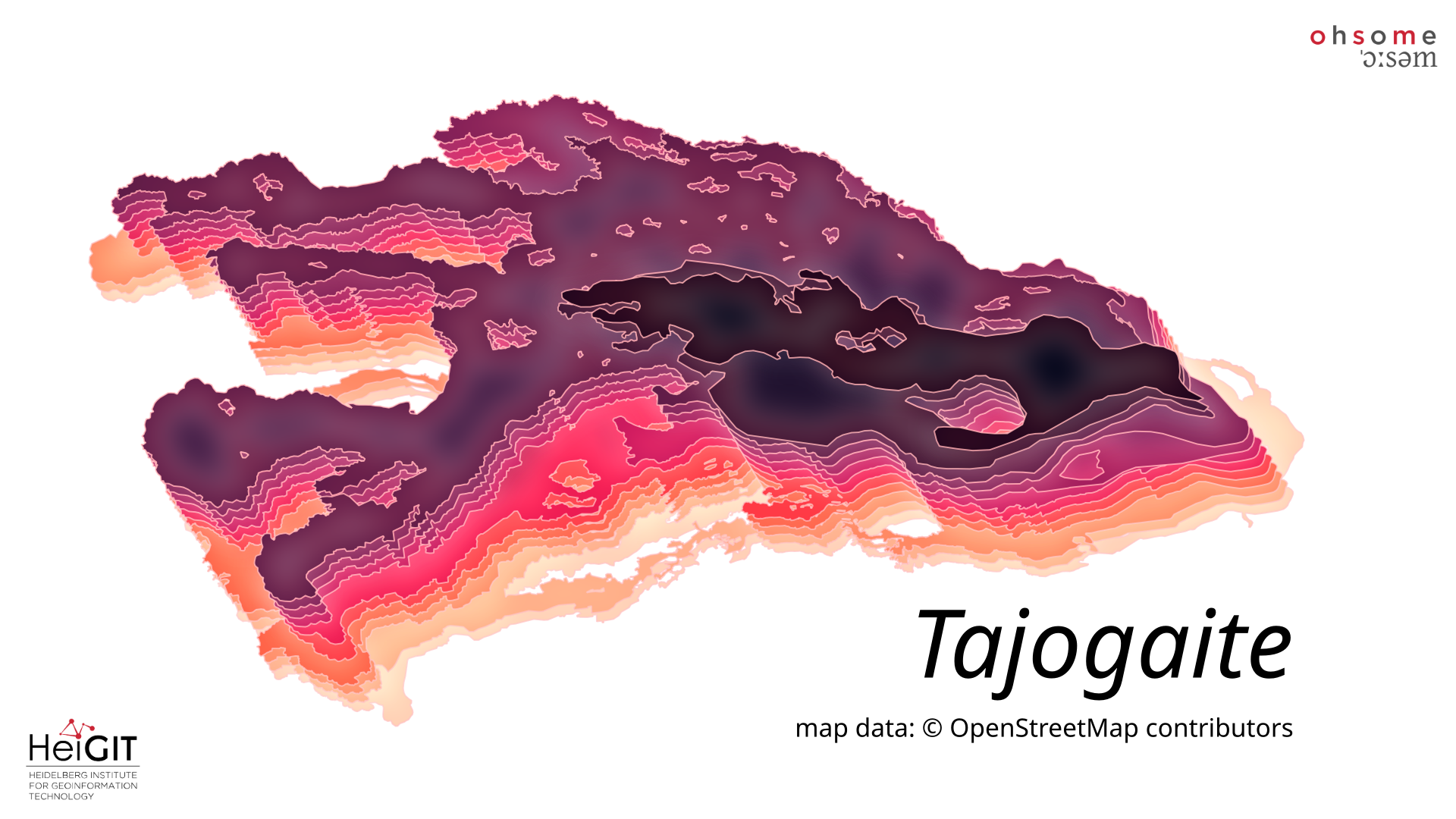
When we introduced ohsome-planet in March 2025, it enabled users to derive a full-history OSM dataset in Parquet format for a specific point in time. However, incorporating newer OSM data required re-running the entire workflow and re-computing contributions that had already been processed. Even though ohsome-planet is blazing fast, this approach still caused unnecessary overhead in terms of computing time and resources. With the new release under the codename „Tajogaite“, ohsome-planet now provides the functionality to continuously produce and analyze all OSM edits in near real time, for the entire globe, a specific country or your custom region of interest.
To achieve this, ohsome-planet consumes the replication .osc diff files provided by the OSM planet server or regional variants of these provided by GeoFabrik. These files contain information about all the OSM edits, e.g. for a particular minute. However, working with these .osc files in a GIS system or analysing the edits is complicated because they only contain information about a single version, but not the actual geometry or tag changes. To be able to derive change, you need to compare to a previous version. This information is not provided in the .osc files.
In order to process these incremental updates captured in the .osc files, ohsome-planet produces a copy of the most recent version of each OSM element and stores these into a RocksDB-based replication store. As new replication files become available, they are transformed into GIS-ready ohsome-planet contributions in Parquet format with native GEO support. The replication store is updated accordingly, enabling ohsome-planet to process the next file. This is similar to the approach of other well-known tools in the OSM software ecosystem such as osm2pgsql, Overpass API’s augmented diffs or OSMCha, but with a crucial difference: Once an ohsome-planet replication Parquet file is created it contains all the information needed to run your analysis, e.g. in DuckDB, QGIS or any other software you prefer.
In addition, ohsome-planet has evolved into a fully-fledged OSM changeset processing tool. Most developers probably rely either on ChangesetMD or a self-written implementation to maintain an up-to-date database with OSM changeset information. We did so too in the past! However, while working with ohsome-planet, we recognized the need for a faster alternative that makes use of more modern features of PostgreSQL and PostGIS. Hence, we extended ohsome-planet so that it can be used to populate a PostgreSQL database with OSM changeset information and keep it up-to-date. With ohsome-planet we can set up an OSM changeset database on our server in less than 15 minutes. The tool also detects changesets missing from the minutely replication files due to a bug in the implementation of the OSM planet server.
Among many other improvements, the tool now also supports S3-compatible object stores as the final output location. This allows Parquet files to be written directly into an S3 bucket, where they become instantly available to downstream tools such as web maps or data science workflows. Writing data directly to S3 simplifies data sharing with collaborators and users and makes it easier to integrate ohsome-planet into modern data orchestration pipelines.
Finally, as ohsome-planet’s functionality has grown, we have significantly improved its documentation. Check out the README and CLI documentation on GitHub to learn how you can use to tool for your use cases.
We look forward to hearing your feedback!