
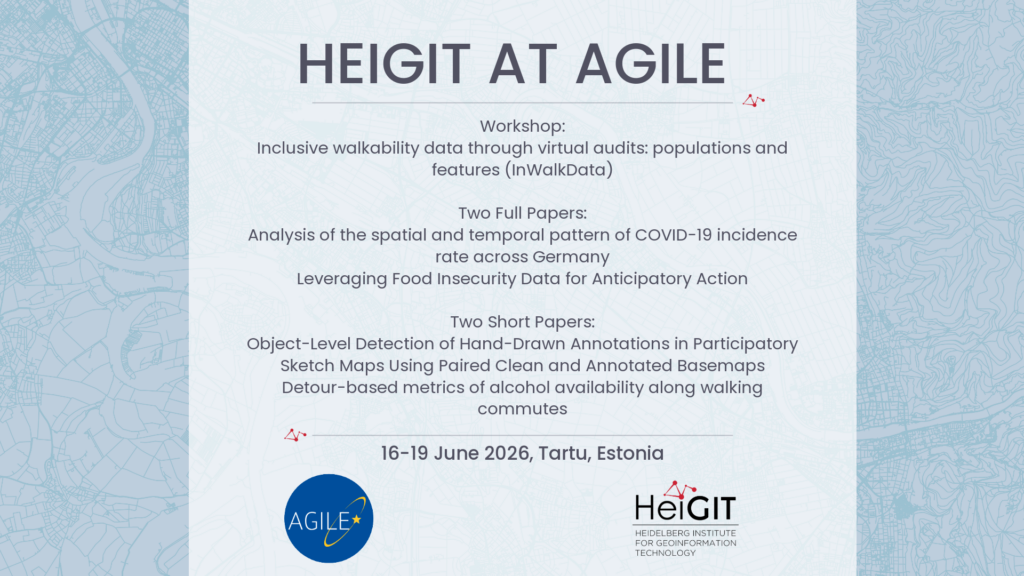
The AGILE Conference 2026 brings together experts in geographic information science to examine how spatial data and technology can help address important social issues. This year’s conference, from June 16 to June 19 in Tartu, Estonia, will cover health geography, participatory mapping, urban accessibility, and the use of data to guide decisions in humanitarian and policy work. HeiGIT will take part by offering a hands-on workshop on inclusive walkability with virtual audits, presenting two full papers on COVID-19 patterns in Germany and the use of food insecurity data for anticipatory action, and sharing two short papers on new methods in participatory sketch map analysis and measuring alcohol availability along walking routes.
Workshop: June 16, 13:45 pm
Inclusive walkability data through virtual audits: populations and features (InWalkData)
Organisers: HeiGIT, Heidelberg University, University of Salzburg, University of Zurich, University of Augsburg, UCL, and Uppsala University
This half-day workshop focuses on inclusive walkability data and on how virtual auditing tools can be used to capture the built-environment features that matter for diverse pedestrian populations (e.g., children, older adults facing age-related mobility restrictions, people sensitive to heat or noise). Before the workshop, the organizers will prepare short lightning talks.
These talks will introduce population groups with specific mobility needs, highlight the built-environment features that affect their walkability, and outline the data attributes needed to describe them. After this shared introduction, the main part of the workshop will be hands-on group work with virtual auditing tools.
Full Papers:
Analysis of the spatial and temporal pattern of COVID-19 incidence rate across Germany
Authors: Sven Lautenbach, Marcel Maurer
The COVID-19 pandemic has caused severe public health issues on a global scale. However, effects were not spatially homogeneous. We analyzed how five selected socio-economic factors (votes for right-wing populist party, share of foreigners, share of highly qualified employees, long-term unemployment rate, share of incoming commuters) shaped the incidence rate in Germany over the pandemic phase. The analysis was performed at the level of the 400 districts. In addition, we analyzed how spatial autocorrelation changed during the course of the pandemic. Because regression residuals were positively spatially autocorrelated, we applied a spatial eigenvector approach to obtain unbiased estimates of our regression coefficients. We also tested for interactions of the regression coefficients with the selected spatial eigenvectors. With the exception of the votes for the right-wing populist party, all predictors showed significant interactions with the eigenvectors. The resulting spatially varying regression coefficient maps indicate that the relationship between incidence rate and the socio-economic indicators might be less straightforward than commonly assumed and seems to be moderated by additional factors. The spatial clusters that emerged during the analysis provide a base for a more detailed analysis of the interplay of regional-scale health politics and regional economic geography.
Leveraging Food Insecurity Data for Anticipatory Action
Authors: Ferdinand Seyffer, Anne Schuss, Marcel Maurer
Anticipatory Action (AA) has become a central pillar of contemporary humanitarian action, aiming to reduce the impacts of climate-related hazards by enabling preventive interventions before crises fully materialize. Food insecurity projections play a critical role in AA, particularly during droughts. Two internationally operating systems, FEWS NET and the Integrated Food Security Phase Classification (IPC), provide widely used assessments and projections of food insecurity. Practitioners are often required to choose between these frameworks when designing AA trigger systems, a challenge that was recently amplified by USAID funding disruptions and the temporary outage of FEWS NET, highlighting the vulnerability of critical humanitarian data streams and the need for informed substitution. This study presents a systematic spatiotemporal comparison and projection skill assessment of FEWS NET and IPC food insecurity data for Somalia between 2017 and 2025. Using harmonized geospatial time series, we evaluate differences in historical assessments and projections, the frequency of projected crisis conditions, and projection accuracy relative to subsequent current assessments. Results indicate strong agreement between the two systems in their assessments of current conditions, but notable divergence in projections: FEWS NET consistently projects slightly higher levels of food insecurity and substantially more frequent Emergency and Famine conditions than the IPC. Projection accuracy is moderate for both systems and characterized by a predominance of positive bias, particularly for higher food insecurity classes. This reflects a precautionary forecasting approach appropriate in humanitarian contexts but must be explicitly considered when defining trigger sensitivity and resource allocation for anticipatory action. Overall, the findings demonstrate that FEWS NET and IPC projections are not directly interchangeable despite their shared classification scale, underscoring the need for dataset-specific trigger calibration.
Short Papers:
Object-Level Detection of Hand-Drawn Annotations in Participatory Sketch Maps Using Paired Clean and Annotated Basemaps
Authors: Clemens Langer, Celina Thomé, Nir Fulman, Steffen Knoblauch, Alexander Zipf, Yulia Grinblat
Automatic extraction of hand-drawn annotations from participatory sketch maps is essential for digitizing community-generated spatial information but remains challenging due to heterogeneous drawing styles, scanning artifacts, and complex basemap content. Existing approaches typically treat markup extraction as pixel-level segmentation or simple image differencing, which struggle under real-world variability. To address this, we formulate annotation extraction as an object-level task by applying a YOLO-based detector to RGB images of annotated maps. In addition, change detection is performed using paired RGB images of annotated and clean maps to isolate user-drawn content from the underlying basemap. Experiments on 18,000 synthetic samples show strong performance across diverse conditions. Object detection on annotated maps alone achieves mAP@50 of 91.5% on satellite imagery and 97.3% on OSM basemaps, while incorporating paired clean maps for change detection improves performance to 97.4% and 98.1%, respectively. Synthetic pretraining further enhances results on real hand-drawn data, indicating that simulated annotations effectively supplement limited labeled samples.
Detour-based metrics of alcohol availability along walking commutes
Authors: Nir Fulman, Johannes Huber
Moderate alcohol use is now recognized as unhealthy. Existing spatial exposure metrics do not account for how people’s movements enable alcohol purchases. We introduce behaviorally informed, detourbased indices tailored to after-work alcohol acquisitions on walking commutes. Using preference surveys of adults in two German cities, we infer empirical “detour budgets” for after-work alcohol runs and embed them in a home-level index capturing the share of transit–home walking paths that include at least one feasible purchase opportunity, and a store-level leverage index capturing how many such paths each outlet can intercept. Under a 250 m detour budget, roughly the extra distance that half of the respondents are willing to walk, half of the stop–home walking segments, and 29% of homes are exposed on all routes. Kiosks, while only about 28% of outlets, account for roughly 35% of this after-work leverage. Applying the indices to European alcohol-policy regimes, we show that a state retail monopoly cuts mean home exposure by about 75%, while targeted removal of the 25% most exposure-imposing outlets achieves almost the same reduction as a selective licensing pattern that shuts more stores. We conclude by outlining extensions toward a broader class of purchase-chain-specific exposure metrics.