
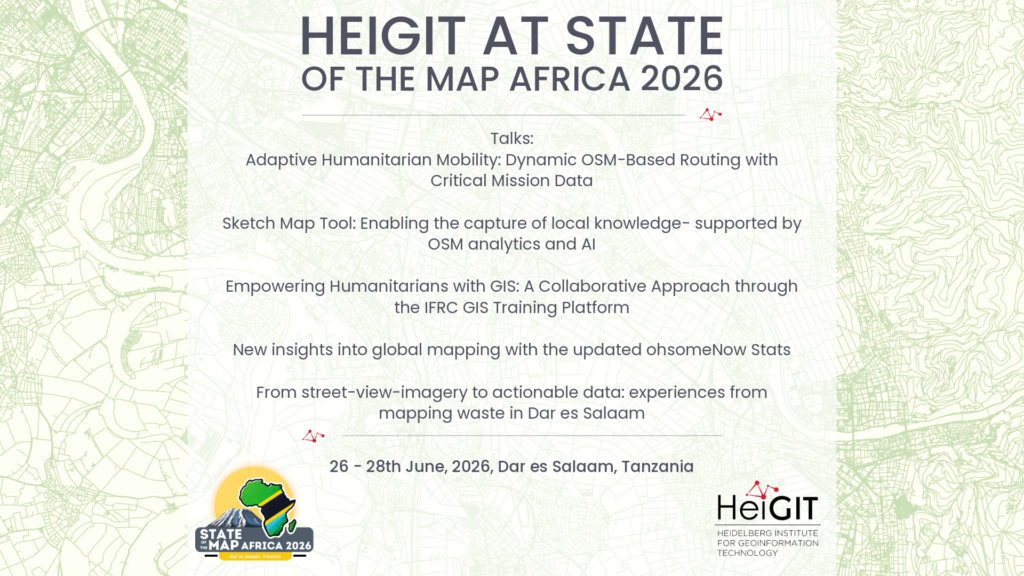
The State of the Map Africa conference is held every two years to celebrate open mapping, open data, GIS, and their impact across Africa. Since it began in Uganda in 2017, the event has become a key gathering for the African OpenStreetMap and Open GIS community. The 2026 conference will be in Dar es Salaam, Tanzania, helping to boost collaboration, innovation, and community growth across the continent. HeiGIT team members will give several talks on how OpenStreetMap, open geodata, and open-source tools can support humanitarian work, collect local knowledge, build GIS skills, perform mapping analytics, and monitor urban environments. Their presentations will include topics such as dynamic OSM-based routing with key data, the Sketch Map Tool, the IFRC GIS Training Platform, the updated ohsomeNow Stats dashboard, and using Street View images to map solid waste in Dar es Salaam.
Talk: Adaptive Humanitarian Mobility: Dynamic OSM-Based Routing with Critical Mission Data
Friday, June 26, 2:20 PM, Auditorium, Humanitarian, English
Speakers: Julian Psotta, Levi Szamek
In humanitarian crises, rapidly changing conditions such as damaged infrastructure, weather hazards, or security threats significantly impact the efficiency and safety of aid delivery and logistics. Standard static routing methods, even those leveraging regularly updated OpenStreetMap data, often fail to quickly adapt when a critical bridge collapses overnight or a newly flooded road blocks previously safe routes.
This talk presents an approach for dynamically incorporating real-time, external operational data directly into mobility analysis. OpenStreetMap provides a foundational role in disaster response, empowering local and remote volunteers to rapidly update map features like road accessibility, infrastructure status, and community resources.
The approach allows integrating additional critical information such as precise flood extents, infrastructure damage assessments, or security conditions provided by humanitarian responders, satellites, or other data sources. This closes the gap between steady OSM changes and information that may not be suitable for OSM or is too temporary.
Implemented within the open-source openrouteservice platform, the system uses an innovative streaming method to update routing graphs rapidly, maintaining high performance and dynamically adapting to changing conditions without time-consuming routing graph rebuilds. The development is currently in preview, with access provided to humanitarian actors on demand.
The talk highlights the integration of dynamic mission-critical data and active OSM mapping efforts into humanitarian routing, showing its current implementation, practical impact, and future potential for proactive, resilient humanitarian logistics.
Talk: Sketch Map Tool: Enabling the capture of local knowledge- supported by OSM analytics and AI
Saturday, June 27, 12:00 PM, Audition Room – 1st Floor – 30, Humanitarian, English
Speaker: Melanie Eckle-Elze
In humanitarian, disaster, crisis, and many further contexts, timely, accurate and relevant geospatial information is often unavailable, outdated, or misaligned with on-the-ground realities. Latest technological developments and data-driven concepts are enabling us to capture the world in unprecedented detail, but can we truly trust global models that lack local insight? Local insights and validation isn’t optional, it’s essential.
One practical tool is the Sketch Map Tool: an open-source web application developed by HeiGIT and the GIScience Research Group at Heidelberg University to bridge the gap between expert geospatial analysis and community-based knowledge. SMT offers a low-barrier, intuitive platform for communities, NGOs, and responders to express local knowledge, risks, needs, and perceptions through freehand sketching, even in places where formal mapping data is sparse or incomplete.
OpenStreetMap plays an important role for SMT, as users can choose from a variety of basemaps, including OpenStreetMap, satellite imagery, or other custom layers. SMT is integrated with the ohsome dashboard, enabling users to visualise OSM data coverage and quality over time for specific regions, identify existing data gaps, and support targeted mapping efforts to improve data quality. HeiGIT is making use of AI-based feature detection to support automatic recognition and digitisation of drawn features, and SMT will soon integrate OpenAerialMap, enabling the use of recent satellite and drone imagery as background layers for sketching.
Talk: Empowering Humanitarians with GIS: A Collaborative Approach through the IFRC GIS Training Platform
Saturday, June 27, 2:40 PM, Auditorium, Humanitarian, English
Speaker: Melanie Eckle-Elze
In many humanitarian contexts, maps can help to save lives and to find the people in need. Yet, a common challenge persists across NGOs and humanitarian networks: while Information Management staff may have data and reporting skills, many lack the geographic information system knowledge needed to fully harness spatial data and to understand which data sets are of best fit.
In this lightning talk, we will introduce the IFRC GIS Training Platform, a collaborative and open source platform developed in close partnership between HeiGIT, IFRC, the British Red Cross, the German Red Cross and the Netherlands Red Cross’ data and digital team. The platform provides a modular and hands-on GIS training curriculum specifically designed to match and support humanitarian use cases, enabling learners with basic IM or data skills, but little or no prior GIS experience — to start creating, using, and analysing spatial data effectively.
The platform includes interactive tutorials, real-world data exercises, a Wiki and practical examples that resonate with humanitarian professionals. Beyond individual learning, it offers Training of Trainers sessions for institutions, networks, communities or teams who want to build internal capacity and run their own training events. In this talk, we will share the platform and its content, stories from those who have used it, and partnership opportunities by joining upcoming ToT programs or adopting the platform in own contexts.
Talk: New insights into global mapping with the updated ohsomeNow Stats
Saturday, June 27, 2:50 PM, Auditorium, Data analysis, English
Speakers: Levi Szamek
ohsomeNow (also referred to as ohsomeNow Stats) is a real-time analytics dashboard and API developed by the Heidelberg Institute for Geoinformation Technology (HeiGIT). It tracks and visualizes OSM contributions globally. ohsomeNow brings transparency and context to OpenStreetMap’s massive, ongoing collaboration. Its fine-grained, flexible analytics help users understand mapping behavior patterns, measure impact of events or campaigns, and monitor trends at country or global levels.
The newly upgraded ohsomeNow Stats dashboard offers near real-time access to all OSM contributions since 2005, enabling detailed, flexible analysis of global mapping activities. Developed in partnership with the Humanitarian OpenStreetMap Team (HOT), it now includes all edits—not just those tagged with hashtags—updated every minute and calculated on demand.
Talk: From street-view-imagery to actionable data: experiences from mapping waste in Dar es Salaam
Sunday, June 28, 11:30 AM, Audition Room – 2nd Floor -80, Innovation, English
Speakers: Levi Szamek
Municipal solid waste is a growing global challenge, with poor waste management, especially open dumping, contributing to environmental degradation, disease transmission, and emerging health risks from microplastics. In East Africa, Tanzania, and especially its commercial capital, Dar es Salaam stands out as a hotspot for mismanaged plastic waste, with waste accumulating in streets, drains, and rivers, including the heavily polluted Msimbazi River.
To address the lack of reliable data on urban waste accumulation, we present a city-scale, open-data-based approach to map visible MSW in Dar es Salaam using deep learning and street-view imagery. In close collaboration with OpenMap Development Tanzania and HeiGIT, we developed an open-source end-to-end workflow that involves collecting, annotating, and processing 360-degree street-view imagery, training a deep learning classification model to detect solid waste, and generating a high-resolution MSW pollution indicator.
The results show several hotspots of waste pollution in Dar es Salaam, mostly located in densely populated informal settlements, while the wards along the coastline show only little waste pollution. Combining the created data with data from OSM, it was recognised that there is a lot of open waste in the immediate vicinity of the drainage system, which can lead to a higher risk of flooding due to clogging. The source data, code, and resulting datasets are publicly accessible, and the entire workflow is transferable to other geographic regions.