
Air pollution caused by fine particulate matter (PM₂.₅) is a major public health concern worldwide. Prolonged exposure to PM₂.₅ is associated with higher rates of cardiovascular and respiratory diseases, which can lead to premature mortality. Among the primary sources of PM₂.₅, biomass combustion for heating remains a critical challenge in cities with cold winters, especially in regions where firewood is widely used due to economic and cultural factors.
This study investigates how meteorological conditions shape PM₂.₅ pollution in Temuco, Chile, a medium-sized city where residential biomass combustion is the dominant source of winter air pollution. Using data from 11 monitoring stations during the 2019 heating season, the authors analyse the influence of temperature, wind speed, relative humidity, atmospheric pressure, precipitation and wind direction on both the spatial and temporal variability of PM₂.₅ concentrations.
The analysis reveals pronounced spatial heterogeneity in PM₂.₅ within the city. Stations Amanecer 1 and Santa Rosa exhibit the highest seasonal mean concentrations (71.4 and 76.1 μg/m³), and spatial interpolation identifies persistent pollution “hot spots” at Amanecer 1, Santa Rosa, Pueblo Nuevo and Pedro Valdivia 1, all with averages above 50 μg/m³. In contrast, nearby stations such as Ñielol and Universidad 2 remain below 16 μg/m³. These sharp intra-urban contrasts indicate that local topography and wood-burning intensity can outweigh broader meteorological conditions in determining pollution levels.
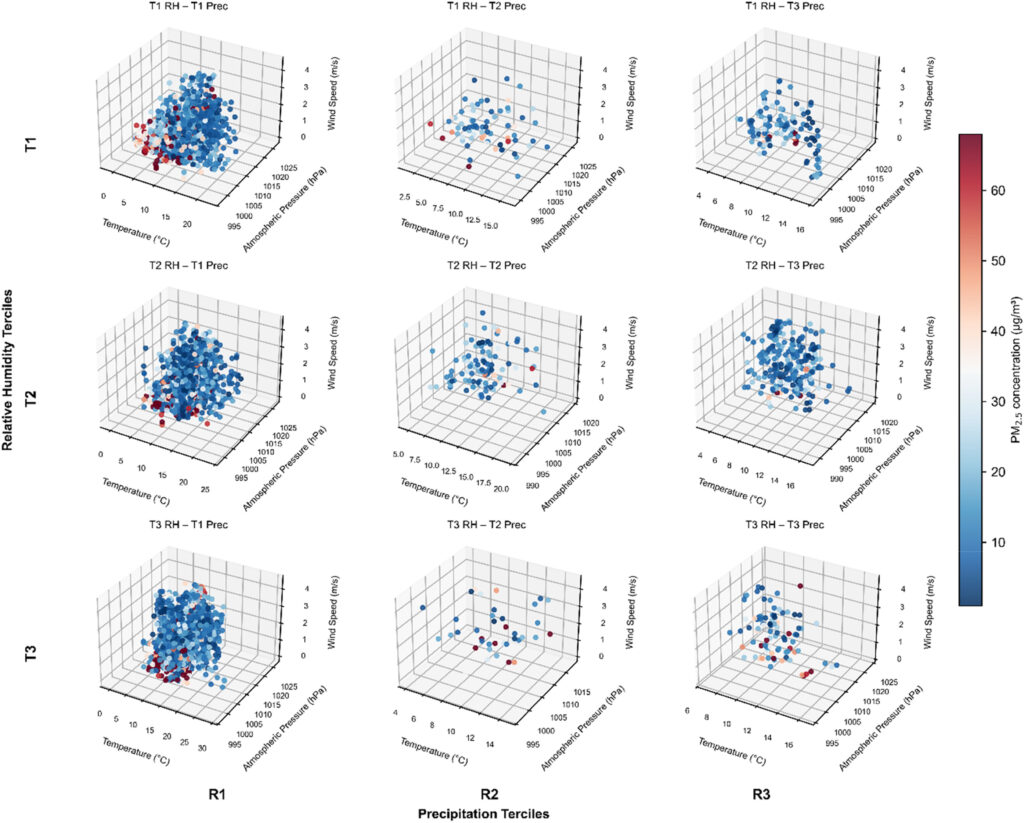
Meteorological variables exert a strong modulating effect on PM₂.₅ concentrations. Temperature and wind speed show clear inverse correlations with PM₂.₅, with Pearson coefficients as low as –0.36 for temperature and –0.30 for wind speed. Calm, cold conditions favour extreme accumulation, with concentrations up to 500 μg/m³ under winds below 3.5 m/s, while values never exceed 375 μg/m³ when wind speeds surpass 5 m/s. On the coldest day, a peak of 996.7 μg/m³ was observed at Amanecer 1, compared to only 46.2 μg/m³ on the warmest day, corresponding to a 95% reduction. Higher wind speeds reduced PM₂.₅ by an average of 86%. Atmospheric pressure presents a weak positive correlation with PM₂.₅, and relative humidity shows only weak positive associations; precipitation and humidity effects are more site-specific and less systematic.
By integrating a dense monitoring network with spatial interpolation and correlation analysis, the study empirically demonstrates that extreme PM₂.₅ episodes in biomass-dependent cities arise from the combined effect of strong local emissions and meteorological conditions that inhibit dispersion. The results underscore the severity of winter air pollution in Temuco and highlight substantial exceedances of health-based guidelines. They also show that meteorological variables are highly relevant for air quality management, supporting the development of weather-based forecasting tools and targeted emission-control measures.
The authors conclude that mitigating PM₂.₅ in such contexts cannot rely solely on short-term restrictions during critical episodes. Instead, structural changes in residential heating practices and technologies are necessary, with careful consideration of affordability to ensure social acceptance. The study contributes to an underrepresented context in the international literature by linking meteorology, biomass combustion and fine-scale spatial variability in a valley city, and highlights the need for future work using multi-year datasets and high-resolution modelling across southern Chilean cities.
Reference: Martinez-Soto, A., Jentsch, M. F., Martinez-Gallegos, V., Duchêne, J., & Zipf, A. (2025). Influence of meteorological variables on PM2.5 concentrations in cities heated with solid fuels: A case study from Temuco, Chile. Atmospheric Environment: X, 25, 100401. https://doi.org/10.1016/j.aeaoa.2025.100401