
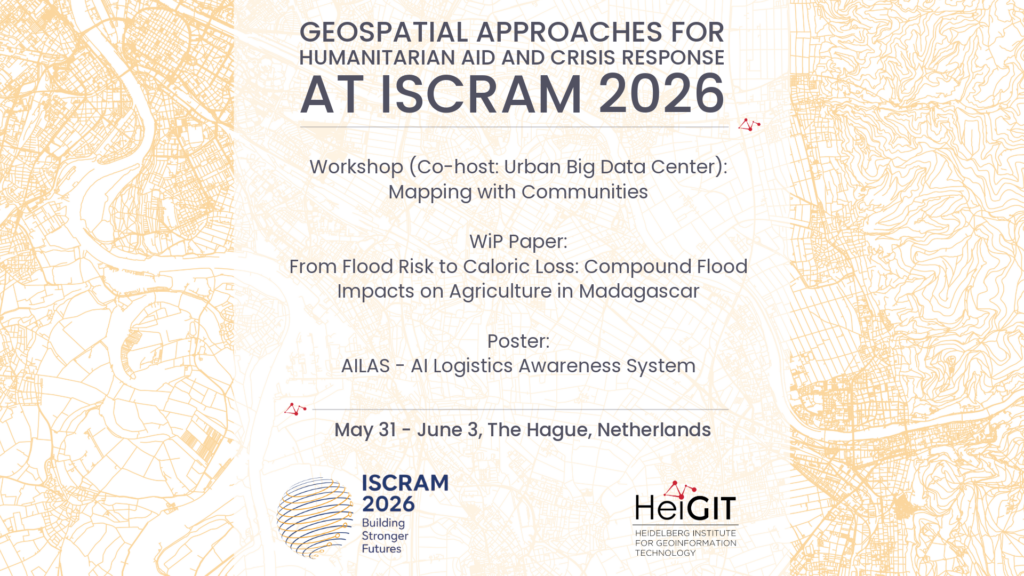
The ISCRAM Conference is an international event focused on information systems for crisis management and disaster response. It brings together researchers and practitioners to discuss how data and technology can help with decision-making during emergencies. This year, the conference will be held from Sunday, 31 May to Wednesday, 3 June 2026, in The Hague, Netherlands. The theme, “Building Stronger Futures,” will address risks from natural hazards, cybersecurity, artificial intelligence, critical infrastructure, and climate change. There will be a special focus on understanding how these risks combine and on encouraging a whole-of-society approach to resilience.
Workshop: Mapping with Communities, co-organized with Urban Big Data Centre
Organizers: Anne Schauss, Diego Pajarito Grajales
Following a successful workshop series at GIScience and AGILE conferences, the “Mapping with Communities” session arrives at ISCRAM on May 31st. Co-organized with the Urban Big Data Center (UBDC), this 4-hour workshop is a space to share ideas about meaningful data co-creation and ways to assess the impact of participatory mapping (PM), a community-driven method relevant for crisis management and anticipatory action.
The session introduces PM not only as a tool for filling data gaps but also as a fundamental process for meaningful data co-creation, prioritizing data sovereignty and ethical engagement, and ensuring that local populations are the primary authors of their own resilience.
The workshop is designed as a collaborative session split into two phases: firstly, a showcase of real-world PM case studies from diverse disaster contexts to highlight practical approaches, tools, and methodological challenges; secondly, an interactive session where participants analyze these case studies, focusing on identifying the impact produced as well as the technical and institutional barriers to integrating community data into crisis management and anticipatory action. The workshop will allow us to assess how these methodologies can be adapted and replicated across diverse disaster contexts. Ultimately, this space would serve as a platform for exchanging experiences and mutual learning to ensure the value of PM is recognized as a cornerstone for building long-term resilience and leveraging community-facing resources for crisis management.
Researchers and practitioners are invited to submit case studies on participatory mapping for a 10-minute presentation. (Email: mappingwithcomm@glasgow.ac.uk)
WiP Paper: From Flood Risk to Caloric Loss: Compound Flood Impacts on Agriculture in Madagascar
Authors: Celina Thomé, Anne Schauss, Marcel Maurer, Sven Lautenbach, Alexander Zipf, Yulia Grinblat
Flood hazards increasingly threaten food production in Madagascar, yet spatially explicit assessments that translate flood exposure into nutritionally meaningful impacts remain limited. This Work-in-Progress (WiP) study develops a spatially explicit framework that combines nationwide crop type mapping, compound flood hazard scenarios, and depth-dependent crop damage functions to estimate flood-induced caloric losses under baseline conditions (2020) and future climate pathways (2030, 2050, and 2080; SSP1, SSP2, SSP3, and SSP5). Using AlphaEarth Foundation embeddings as geospatial feature representations, the study trains a custom crop classification model that achieves 72% overall accuracy to map key staple crop groups across Madagascar. Potential caloric production was then estimated and combined with compound flood depth maps to derive crop-specific relative losses, district-level spatial impact patterns, and national absolute caloric loss trajectories. Under the 2020 baseline flood scenarios, estimated caloric losses correspond to people-equivalent shortfalls based on the annual minimum dietary energy requirements of ~3.3 million people in a 1-in-5-year event and ~5.1 million people in a 1-in-10-year event, showing that even relatively frequent flood events can have substantial implications for food availability. In rarer, high-magnitude scenarios, including 1-in-50-year and 1-in-100-year events, these impacts increase substantially, with losses in the 1-in-100-year event exceeding 9 million people-equivalent shortfalls. Future climate pathways suggest that these impacts intensify over time, with the largest losses projected under high-emission scenarios. By shifting the proxy from flooded area to human-centered indicators (calories and people-equivalents), the framework provides decision-relevant evidence for preparedness planning, anticipatory action, and humanitarian prioritization.
Poster: AILAS – AI Logistics Awareness System
Authors: Ferdinand Seyffer, Marcel Maurer, Anne Schauss, Alexander Zipf
Presenter: Anne Schauss
Reliable logistics are essential for humanitarian aid, especially in remote regions where the “last mile” often depends on unpaved roads. Unlike paved roads, these routes are highly vulnerable to weather-related impacts, including rainfall, flooding, erosion, and rutting, which can reduce or completely block access. Existing routing services provide little reliable information for these poorly mapped areas, while manual reconnaissance is often too slow and costly for emergency operations. As a result, aid delivery faces delays, uncertainty, and increased risk of failing to reach vulnerable communities. The AI Logistics Awareness System (AILAS) project addresses this challenge through a weather-adaptive, AI-supported routing approach. Using Street-Level Imagery (SLI), deep learning models classify the passability of unpaved roads and combine these results with weather data, terrain information, satellite imagery, and precipitation forecasts. This enables probabilistic predictions of current and future road accessibility, even for road segments without direct imagery. These predictions are integrated into the openrouteservice routing engine, where impassable roads are automatically penalized or excluded to generate more reliable routes.