
The FOSS4G Europe conference, a European extension of the Open Source Geospatial Foundation (OSGeo) annual event, connects professionals in the geoinformation software realm. OSGeo, as an international association, emphasizes geoinformatics, cartography, and open standards, fostering data sharing, collaboration, and innovative problem-solving across various domains.This conference series, initially known as FOSS/GRASS User Conference and later as FOSS4G, arrives again in Romania, offering local professionals and students access to world-class education and insights from global experts, all while facilitating networking and knowledge exchange.
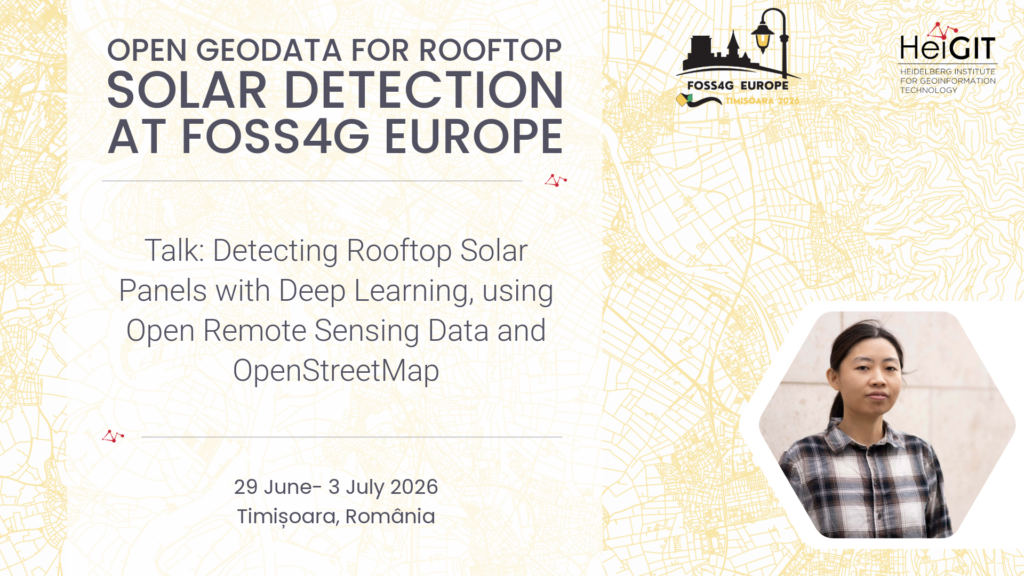
Talk: Detecting Rooftop Solar Panels with Deep Learning, using Open Remote Sensing Data and OpenStreetMap
Speaker: Gefei Kong
How dependent is your town on the electricity grid? How many buildings are supplied by rooftop solar panels? How much unused potential is there to leverage the power of the sun?
We built a deep learning model using FOSS4G and open remote sensing data for Germany. With this model, you can detect which buildings have rooftop solar panels at a neighbourhood level. The input data is orthophotos and OpenStreetMap building footprints, which we feed into a 4-channel image classification model.
The results of the model are visualised in the Rooftop Solar assessment tool of the Climate Action Navigator (https://climate-action.heigit.org) from HeiGIT (https://heigit.org).
In this talk, we will demonstrate our results through our assessment tool. We will also explain the design of our model and how we used OpenStreetMap tagging to significantly speed up the creation of training data for our supervised learning approach.