
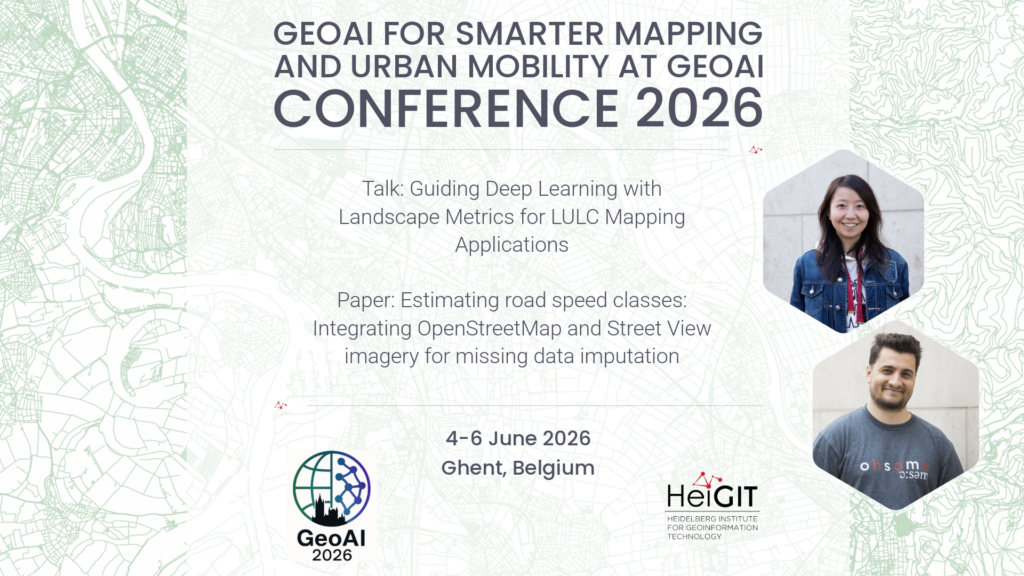
The GeoAI conference is the 1st international conference focused on geospatial artificial intelligence. The conference will be held from 4-6 June 2026 in Ghent, Belgium. It aims to bring together scholars, researchers, and professionals from academia, industry, and government to exchange ideas and explore how GeoAI can advance science and shape society. HeiGIT will present research on knowledge-guided deep learning for land-use and land-cover mapping, as well as scalable traffic speed estimation using OpenStreetMap and Street View imagery.
Talk: Guiding Deep Learning with Landscape Metrics for LULC Mapping Applications
Session #4: LULC mapping (June 4, 14:30-16:15)
Presenter: Nikolaos Kolaxidis
Deep learning has become a core methodology in GeoAI and remote sensing, yet many models operate with limited integration of geographic principles, leading to high computational costs and geographically implausible predictions, particularly in heterogeneous landscapes. In this work, we explore how landscape-related geographic knowledge can be explicitly encoded and integrated into deep learning models as a regularization signal. Building on an initial analysis of multi-level landscape metrics derived from OpenStreetMap, we show that these metrics capture structural similarities and differences across regions and can serve as a transferable reference. We propose a two-head architecture based on SegFormer, where a standard semantic segmentation head is complemented by a regression head that predicts landscape metrics from the segmentation output. A composite loss combines cross-entropy with a landscape metrics-based regularization term, enabling geographically informed training. Preliminary experiments demonstrate model convergence but highlight challenges related to computational overhead and loss design, motivating the use of distributional losses for more informative guidance. Overall, this work provides a first step toward knowledge-guided deep learning in GeoAI, emphasizing the role of spatial structure, scale, and geographic context for more interpretable and sustainable models.
Paper: Estimating road speed classes: Integrating OpenStreetMap and Street View imagery for missing data imputation
Session #9: Street-level visual intelligence and perception 2 (June 5, 14:30-16:00)
Presenter: Shiyu Tang
Traffic speed is a significant indicator for evaluating road network performance and supporting intelligent transportation systems, as it informs congestion management, routing, and operational decisions. Although traffic information is available from commercial platforms and sensor-based monitoring systems, such data are often costly, proprietary, or spatially limited, which restricts their broader usability. To overcome these limitations, we designed a spatial prediction model based on the Graph Sample and Aggregation (GraphSAGE) to infer traffic speeds in unobserved areas. Instead of predicting continuous speed values, we classified traffic into speed classes, which enhanced model robustness in the absence of historical observations and better reflected long-term typical traffic patterns relevant to downstream applications such as routing, emission assessment, and traffic management. Taking Berlin as a case study, the model incorporated multi-source features, including topological features, OpenStreetMap-based road features, and semantic Street View imagery indicators. Uber Movement average speed data were used as supervised learning labels. Results showed that the multi-source feature fusion improved the prediction performance, with the F1 score increasing from 0.6228 to 0.6917. Feature analysis revealed that OSM contextual features contributed the most under limited label coverage, while Street View imagery added complementary information to facilitate model discrimination. Despite only 28 % of road segments being covered by Uber observations, similar feature patterns between labeled and unlabeled areas enabled the model to generalize and infer missing speed data citywide. The framework makes scalable and low-cost speed class inference available for urban traffic monitoring and modeling.