As countries accelerate energy transitions, ensuring that decarbonization advances social as well as environmental goals has become a challenge of Energy Justice. Energy poverty (EP), defined as the inability of households to access adequate energy services for essential needs such as heating, cooling, and lighting, is a multidimensional phenomenon shaped by income levels, housing conditions, and infrastructural access. Subsidies, building retrofitting programs, and electrification initiatives have been introduced in multiple countries to mitigate EP. However, the distributive effects of these policies remain poorly understood. Existing expenditure-based and multidimensional EP indices often fail to capture the territorial friction induced by energy transition policies (ETPs), which restricts their capacity to identify how regional climate specificities modulate household vulnerability over time.
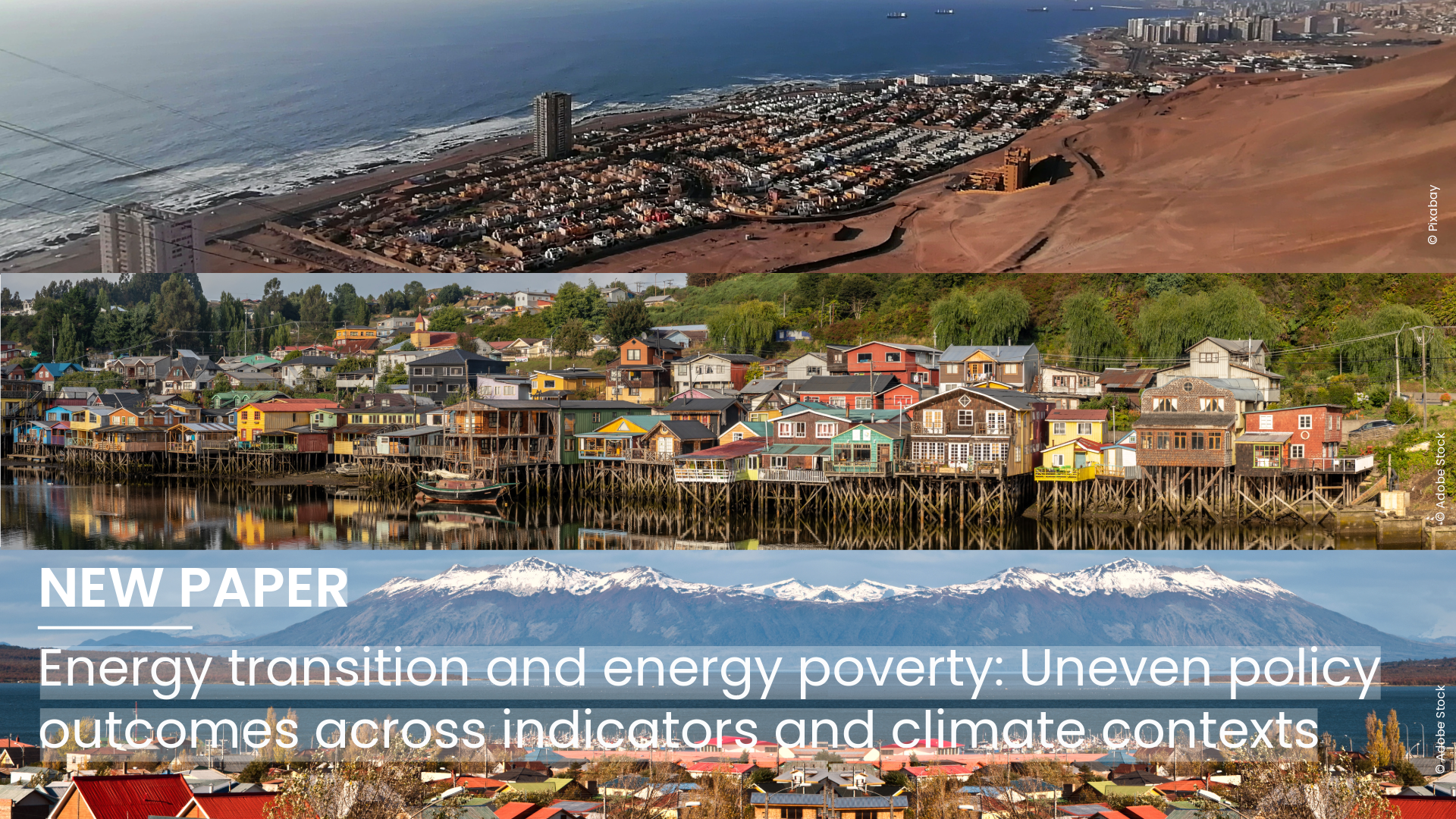
To address this challenge, this study proposes a framework for assessing the impacts of ETPs on EP. It integrates policy interventions, EP indicators, scenario modelling, and climate-sensitive spatial analyses within a common analytical structure. The framework is organized into six sequential layers: (1) defining the territorial context, indicators, and policies; (2) translating policy interventions into indicator input variables and policy mechanisms; (3) constructing baseline and policy implementation scenarios; (4) recalculating economic and multidimensional EP indicators under each scenario; (5) evaluating impacts across climatic zones, socioeconomic groups, and territorial units; and (6) assessing policy sensitivity and energy justice outcomes. As the framework is not tied to a specific indicator, policy, climate classification, or national dataset, it can be adapted to other countries. Chile is used as the empirical application due to its climatic diversity, extensive latitudinal gradient, and pronounced territorial inequalities.
Under full implementation of the analyzed policies, national EP would decrease by 24.78%. However, the modeled reductions are spatially uneven and socially stratified. The largest reductions are concentrated in the temperate and humid southern zones (Cfc −44.4%, Cfb −34.5%), while the arid and semi-arid zones (BSk, BWk) show reductions of 21.7%. Middle-high and high-income households experience greater benefits (−29.1%) than low-income households (−23.5%). Economic indices show larger average reductions (−27.3%) than multidimensional ones (−22.0%), indicating that the policies affect expenditure and efficiency more effectively than structural access deficits. The National Energy Policy (NEP) is associated with the largest modeled reduction (−38.2%), and its position relative to the other policies remains unchanged when the MEPI deprivation threshold is lowered from 0.35 to 0.30. The Atmospheric Prevention and Decontamination Plan (APDP) reduces EP in the zones where it is applied (−11.06% in Cfc). At the same time, it produces a 2.44% increase in measured national EP through statistical reclassification in sample-dependent indices, rather than through a deterioration in the conditions of non-intervened communes.
The findings indicate that a just transition in Chile requires territorial and social targeting that integrates thermal vulnerability, housing efficiency, and income level, supported by differentiated funding, regional adaptation, and evidence-based monitoring.
Reference: Martinez-Soto, A., Sanhueza-Catalan, D., Castro-Coliqueo, K., Lehmann, R., Zipf, A., & Knoblauch, S. (2027). Energy transition and energy poverty: Uneven policy outcomes across indicators and climate contexts. Energy Policy, 221, Article 115700. https://doi.org/10.1016/j.enpol.2026.115700