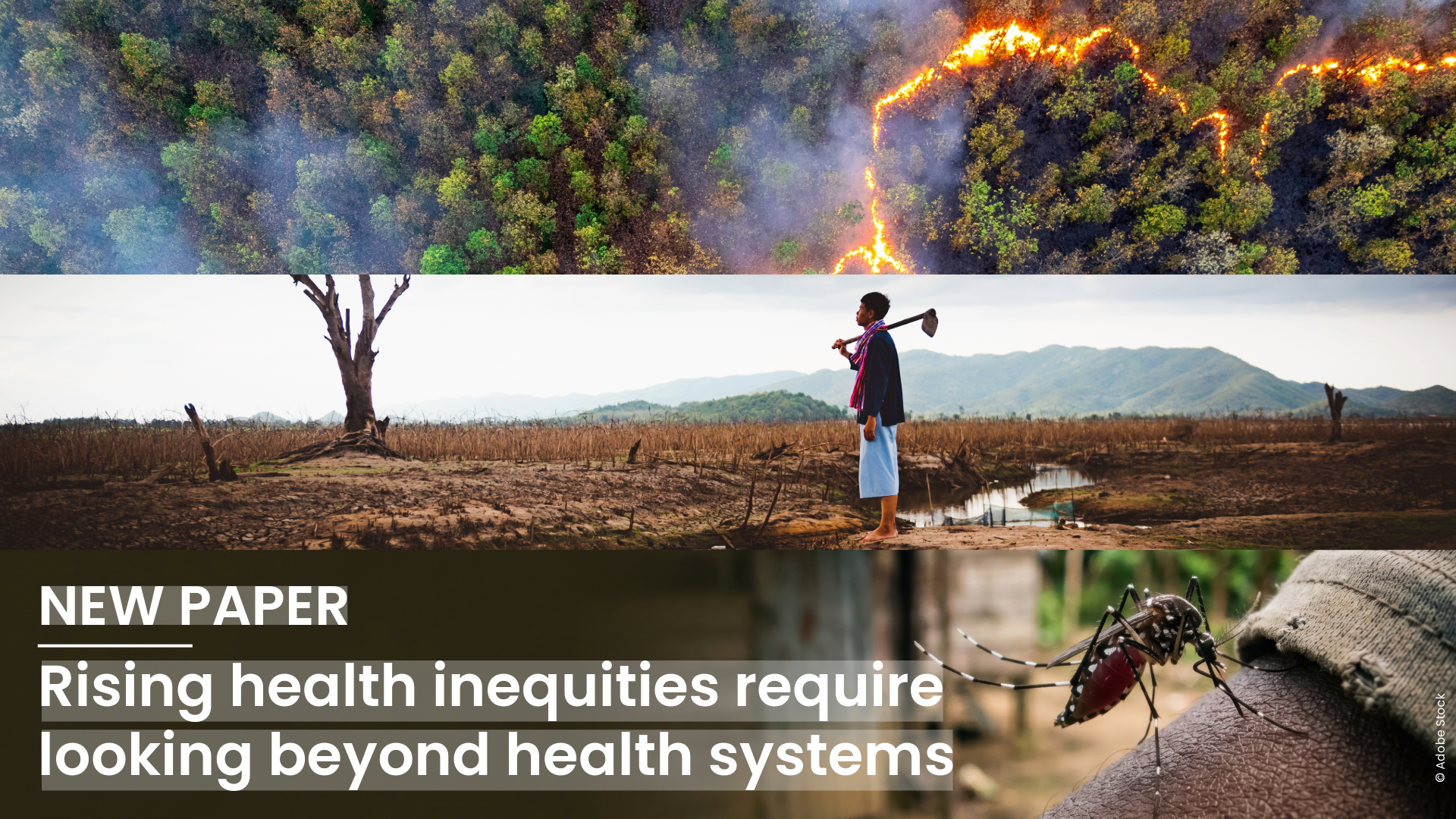
The scale of this crisis is already visible in global environmental indicators. Seven of eight safe and just Earth System Boundaries have already been breached. Most of the world’s population is affected by multiple boundary violations. Health impacts including non-communicable disease, infectious disease, malnutrition, and mental illness are rising, while adaptation efforts lag behind. These impacts are distributed unequally at the global level, with low- and middle-income countries such as those in Sub-Saharan Africa bearing disproportionate harm despite minimal historical emissions. Impacts are also distributed unequally within high-income regions, where poorer and older populations are hit hardest.
These unequal impacts stem from underlying differences in how populations experience climate and environmental risk. Health inequities emerge from uneven exposure, vulnerability, and coping capacity. These factors are shaped by geography, socioeconomic status, health system strength, and access to resources. Environmental systems and social structures shape individual behavior, for example through diet and vector-control practices, and aggregated behavior feeds back into the planetary crisis through emissions, pollution, and biodiversity loss.
Left unaddressed, these dynamics tend to widen existing gaps over time. Vulnerable populations face overlapping risks, described as eco-syndemics, and have fewer adaptive resources, so disadvantage compounds over time in what the authors call an inequality reinforcement trajectory. Wealthier groups can adapt more easily but often have weaker incentives to change the consumption patterns that drive the crisis. Increased air conditioning use illustrates this trade-off since it improves heat resilience for some groups while worsening urban heat island effects and emissions for others.
In response to this reinforcing pattern, the authors call for further research on socio-environmental feedback loops and the limits of behavior change, alongside integrated policy that combines structural reform, such as limiting climate change, protecting biodiversity, and reducing pollution, with support for individual adaptation. They emphasize that responsibility cannot rest on individuals alone.
Box 1. Highlighted avenues for research and policy action
Further research needed to advance the current knowledge and facilitate action on health equity under the triple planetary crisis includes:
- Closing geographic data and monitoring gaps in exposure and vulnerability assessment. For example, studies that combine Earth observation, routine health data, and participatory or citizen-generated geodata to produce fine-scale, longitudinal indicators of environmental exposure and social vulnerability in regions where official data are sparse.
- Compound and cascading risks in an eco-syndemic perspective. For example, studies that assess how co-occurring hazards such as extreme heat, pollution, and flooding interact with pre-existing disease burdens, and how such compound exposures cluster spatially in deprived neighbourhoods rather than being distributed independently.
- Improving the effectiveness of responses to protect vulnerable populations from locked-in climate and environmental risks resulting from past emissions and ongoing environmental changes. For example, studies that look at greening in urban design and projections of heat-related morbidity and mortality, differentiating between health risk groups and environmentally unequal populations.
- Ways to shift consumption patterns to reduce the most severe outcomes and inequities of the planetary crises. For example, studies that test interventions such as household counseling to increase the consumption of plant-based healthy foods in various populations, while assessing outcomes such as micronutrient intake, health, and environmental impacts and examining differences in the motivations and barriers influencing dietary transitions across low- and high-income groups.
- Equity effects of climate and environmental policies themselves. For example, quasi-experimental studies evaluating whether interventions such as low-emission zones, urban greening programmes, or heat action plans reduce or inadvertently widen health inequities through pathways of health co-benefits.
- Role of awareness, empowerment, and planetary literacy among individuals and communities in catalysing change and pathways by which ecosystem-based interventions interact with community empowerment. For example, studies that integrate nature-based solutions (e.g., biodiversity-friendly lawns in public spaces) in urban settings with school- and community-based literacy interventions to promote acceptance and stewardship of the ecosystems.
- Economic value and health co-benefits and trade-offs of mitigation and adaptation strategies. For example, studies that quantify the health and productivity benefits of heat resilience and the longer-term co-benefits of climate change mitigation, or studies that estimate the health benefits and their economic value of forest and wetland conservation and restoration projects.
Approaches for coordinated action to advance health equity include:
- Redesigning urban and living environments through a health equity lens. This involves, for example, urban planners considering bicycle infrastructure needs of communities with different income levels to facilitate inclusive mobility, hence promoting an active lifestyle and reducing carbon emissions from transport, and local governments engaging deprived urban residents in community gardening in urban and peri-urban settings, with impacts on food transitions, reduced pollution, increased pollinator habitats, and improved urban climate.
- Promoting more equitable access to essential resources such as housing, energy, recreational areas, sustainable transportation, and healthcare. This can be achieved through policymakers at different levels of government adopting rights-based approaches focusing on resilience and prevention to reduce inequities that arise from market-based mechanisms.
- Directing climate and health finance toward the most affected populations. For example, prioritising adaptation and loss-and-damage funding for climate-resilient primary care, water and sanitation, and heat protection in the regions least responsible for and most affected by the planetary crises.
- Empowering communities as producers of knowledge, not only recipients. For example, supporting participatory mapping and community-led risk assessments in informal settlements, where locally generated geodata can guide drainage, greening, and health outreach investments, and involving communities in designing the programmes that meant to change their behaviour, for instance, through participatory budgeting or citizen assemblies.
- Building equitable environmental health surveillance infrastructure. For example, national and municipal agencies integrating high-resolution environmental data, health registries, and community-based monitoring into open, interoperable systems that make inequities visible where they arise, and investing in data capacity in low- and middle-income countries so that adaptation planning is not confined to data-rich settings.
- Embedding distributional health impact assessment in climate policy instruments. For example, requiring national adaptation plans, urban development schemes, and mitigation policies to undergo spatially explicit equity audits that identify which population groups and neighbourhoods gain or lose, before implementation rather than retrospectively.
Reference: Toprakkiran, N., Treskova, M., Tosun, J. et al. Rising health inequities require looking beyond health systems. Nat Hum Behav 10, 1618–1621 (2026). https://doi.org/10.1038/s41562-026-02565-7
Romanello, M. et al. The 2025 report of the Lancet Countdown on health and climate change: climate change action offers a lifeline. Lancet. 406, 2804–2857 (2025). doi:10.1016/S0140-6736(25)01234-5