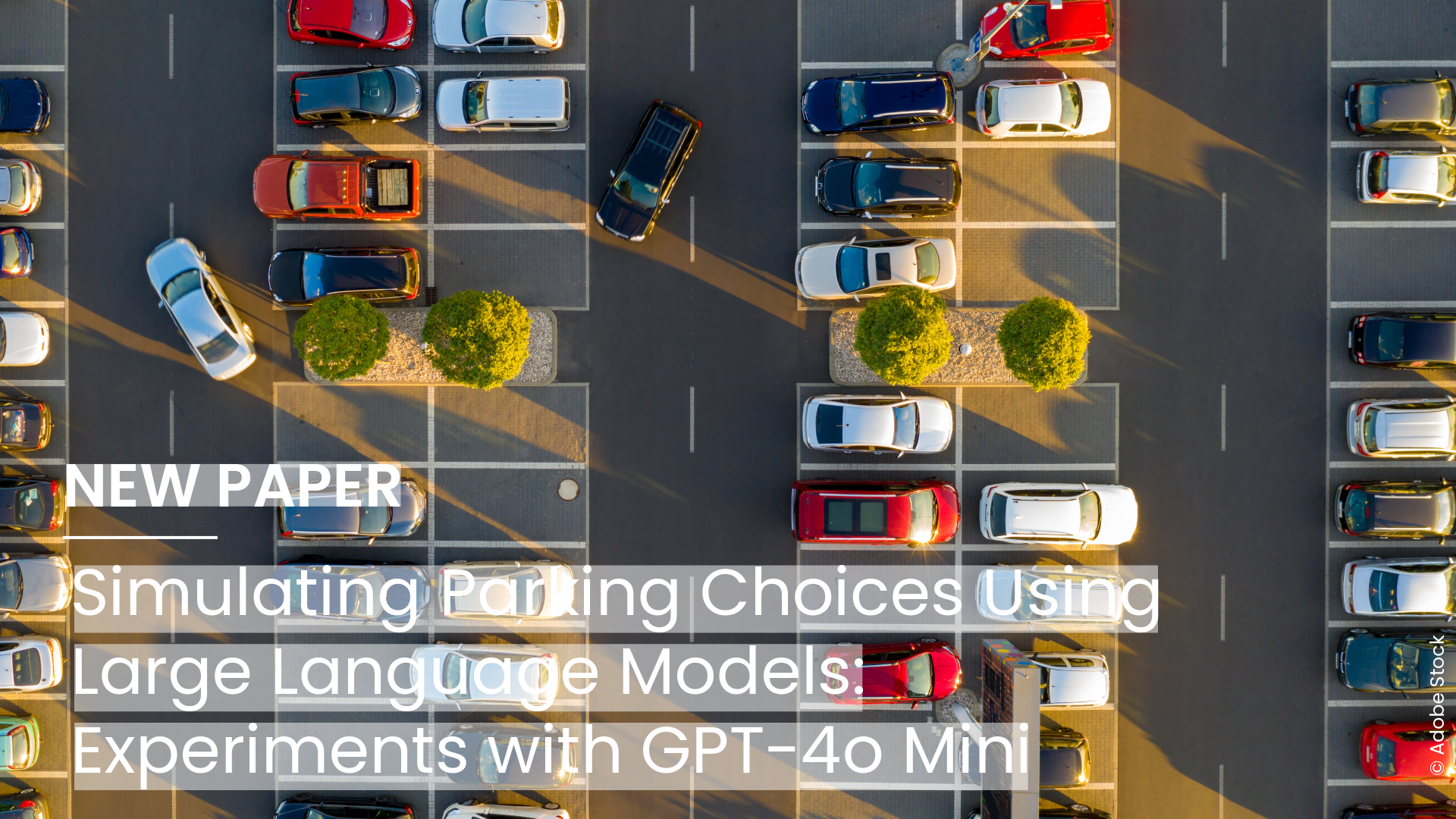
Parking remains a significant challenge in dense urban environments. Competition for parking spaces leads to increased congestion, prolonged search times, elevated emissions, and inefficient urban land use. To investigate how drivers select among parking options, researchers often use stated choice experiments, in which participants evaluate hypothetical parking alternatives and indicate their preferred choice. However, obtaining data from large, representative samples using these methods is often costly and time-consuming.
This study explores the use of GPT-4o mini, a Large Language Model (LLM), to simulate parking choices in urban environments, potentially assisting in the design of traditional preference studies. We conducted a series of experiments where the model acted as a survey participant, choosing between parking options based on attributes and sociodemographic profiles, which we term Personas. GPT-4o mini’s choices align with findings in parking behavior literature. The model consistently selects lower-cost parking options while minimizing walking distances and search times, demonstrating utility-maximizing decision-making. Additionally, its responses reveal a clear willingness to trade-off between price and time savings, reflecting diminishing marginal utility and an increased willingness to pay with higher income levels. It also exhibits complex trends not well-documented in existing literature, such as older personas’ heightened sensitivity to reduced walking distances. This highlights the potential of LLMs to emulate hypothetical scenarios across diverse populations, geographical settings, and potential policies and technological innovations. We discuss the broader implications of using LLMs for preference study design, pilot testing, transportation modeling, and the potential ethical concerns surrounding their future application in simulating human decision-making.
Reference: Fulman, N., Memduhoğlu, A., & Zipf, A. (2025). Simulating parking choices using large language models: Experiments with GPT-4o Mini. Frontiers in Artificial Intelligence and Applications, 92–105. IOS Press Ebooks – Simulating Parking Choices Using Large Language Models: Experiments with GPT-4o Mini