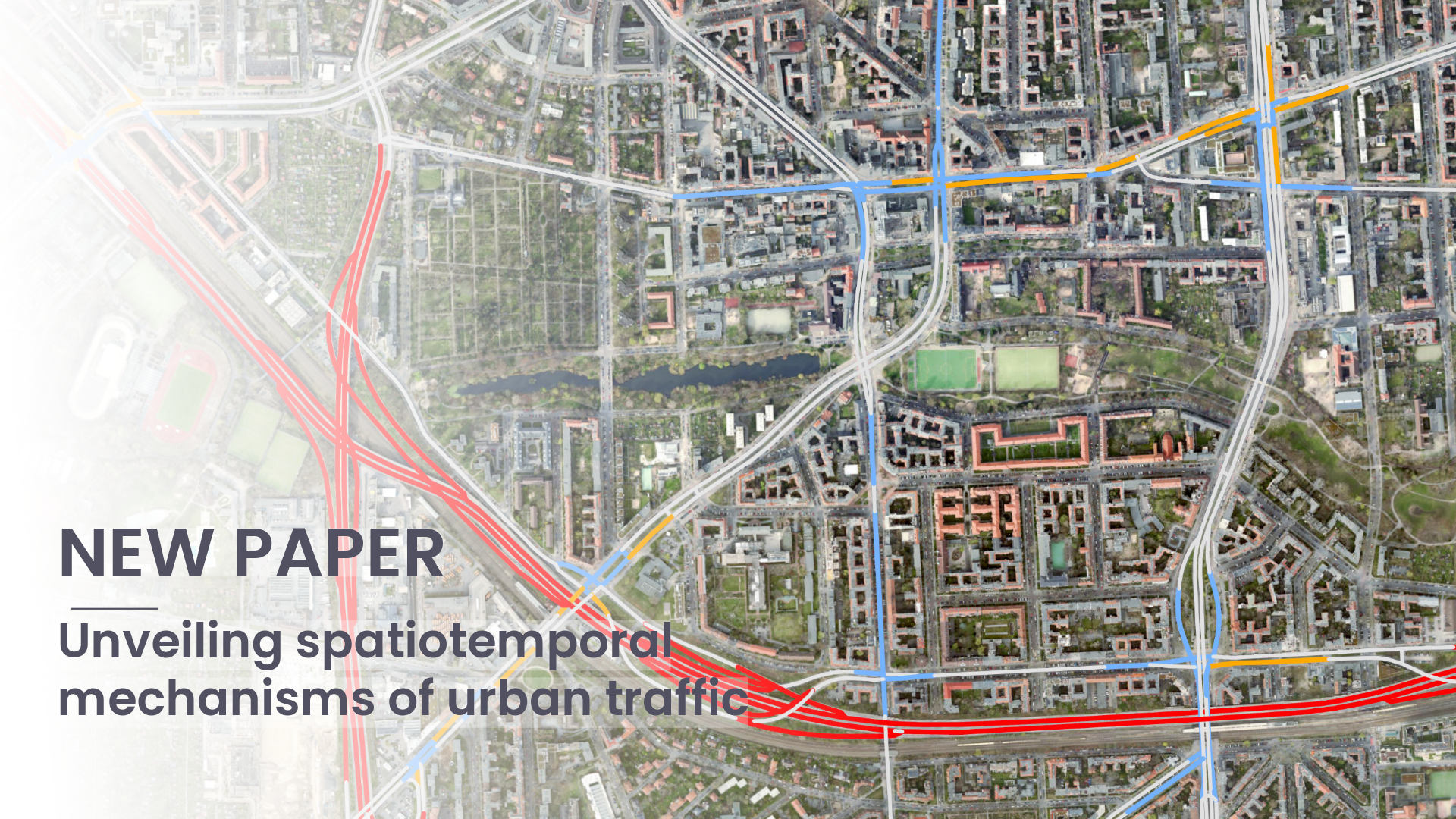
This study examines Berlin, Germany, where the authors modeled street-level traffic speeds at four key times: nighttime, morning peak, flat peak, and evening peak. They built the selected road network using OpenStreetMap and represented it as a graph, where road segments were connected based on their topology. The model was trained with Uber Movement speed data and used OpenStreetMap-based road attributes, population density, road facilities, and street-view-derived activity indicators, including visible pedestrians, cars, bicycles, and trucks. It then estimated speeds for about 72% of the selected road network where Uber data was missing.
The GraphSAGE model had a mean absolute error of 5.73 km/h and captured the overall pattern of traffic speeds in Berlin. Predicted speeds were lower in the city center and higher in the outer areas, often going above 50 km/h. The researchers then used Geographical and Temporal Weighted Regression to better understand the model’s results and see how the importance of different factors changed across locations and times.
The analysis found that speed limits and road type were usually associated with higher predicted speeds. In contrast, higher population density, more pedestrians detected in street-view images, and more traffic signals were generally associated with lower predicted speeds. By grouping the local regression results, the authors found four clear GTWR behavior clusters in the city. These clusters reveal how the model shifts the relative importance of different features across areas.
Overall, the paper shows that combining graph neural networks with interpretability methods can make traffic speed estimates more transparent, especially in cities where complete public speed data is unavailable.
Reference: Tang, S., Rui, J., Lautenbach, S., Ludwig, C., Randhawa, S., Knoblauch, S., & Zipf, A. (2026). Unveiling spatiotemporal mechanisms of urban traffic: Multi-scale determinants and explainable street-level dynamics of a graph neural network in Berlin. Journal of Transport Geography, 135, Article 104754. https://doi.org/10.1016/j.jtrangeo.2026.104754