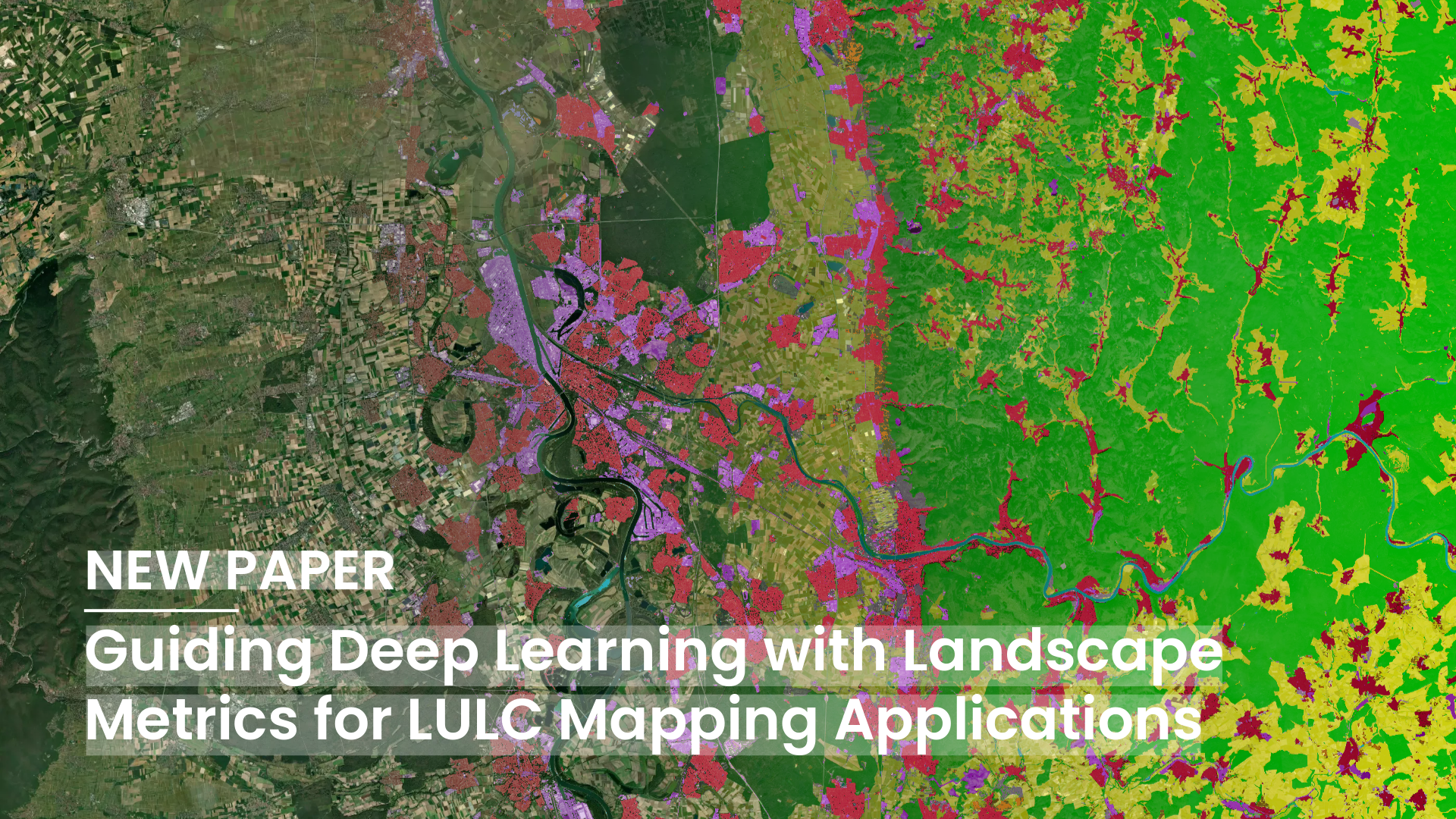
Deep Learning (DL) has become a core methodological pillar in remote sensing and GeoAI, enabling large-scale applications such as Land Use Land Cover (LULC) mapping, object detection, and spatiotemporal prediction. Despite impressive performance gains, current DL models often operate with limited integration of geographic principles, leading to high computational demands and outputs that lack logical spatial consistency.
In LULC mapping, humans can often easily detect misclassifications even without domain expertise, as they integrate spatial context and other intuitive observations of geographic objects.
This knowledge of spatial relations, is often probabilistic, context-dependent, and scale-sensitive rather than deterministic. As a result, it cannot be directly used in DL models, which require differentiable information.
This work investigates how geographic knowledge can be integrated into deep learning models as a regularization signal. Using landscape metrics derived from OpenStreetMap, we show that these metrics capture structural similarities and differences across regions and can serve as transferable geographic references. We propose a two head architecture based on SegFormer, combining semantic segmentation with a regression head that predicts landscape metrics from the segmentation output. A composite loss integrates cross entropy with a landscape metrics based regularization term to guide training. Initial experiments demonstrate stable convergence while highlighting challenges in computational efficiency and loss design. Overall, this work represents a first step toward GIScience-guided DL, emphasizing spatial structure and geographic context for more interpretable and sustainable models.
Reference: Kolaxidis, N., Ludwig, C., Adamiak, M., & Zipf, A. (2026, May 20). Guiding Deep Learning with Landscape Metrics for LULC Mapping Applications. The 1st International Conference on Geospatial Artificial Intelligence (GeoAI 2026), Ghent, Belgium. Guiding Deep Learning with Landscape Metrics for LULC Mapping Applications
This paper is part of a broader research project on integrating geographical knowledge into Artificial Intelligence models for enhanced accuracy: GeoWiKI