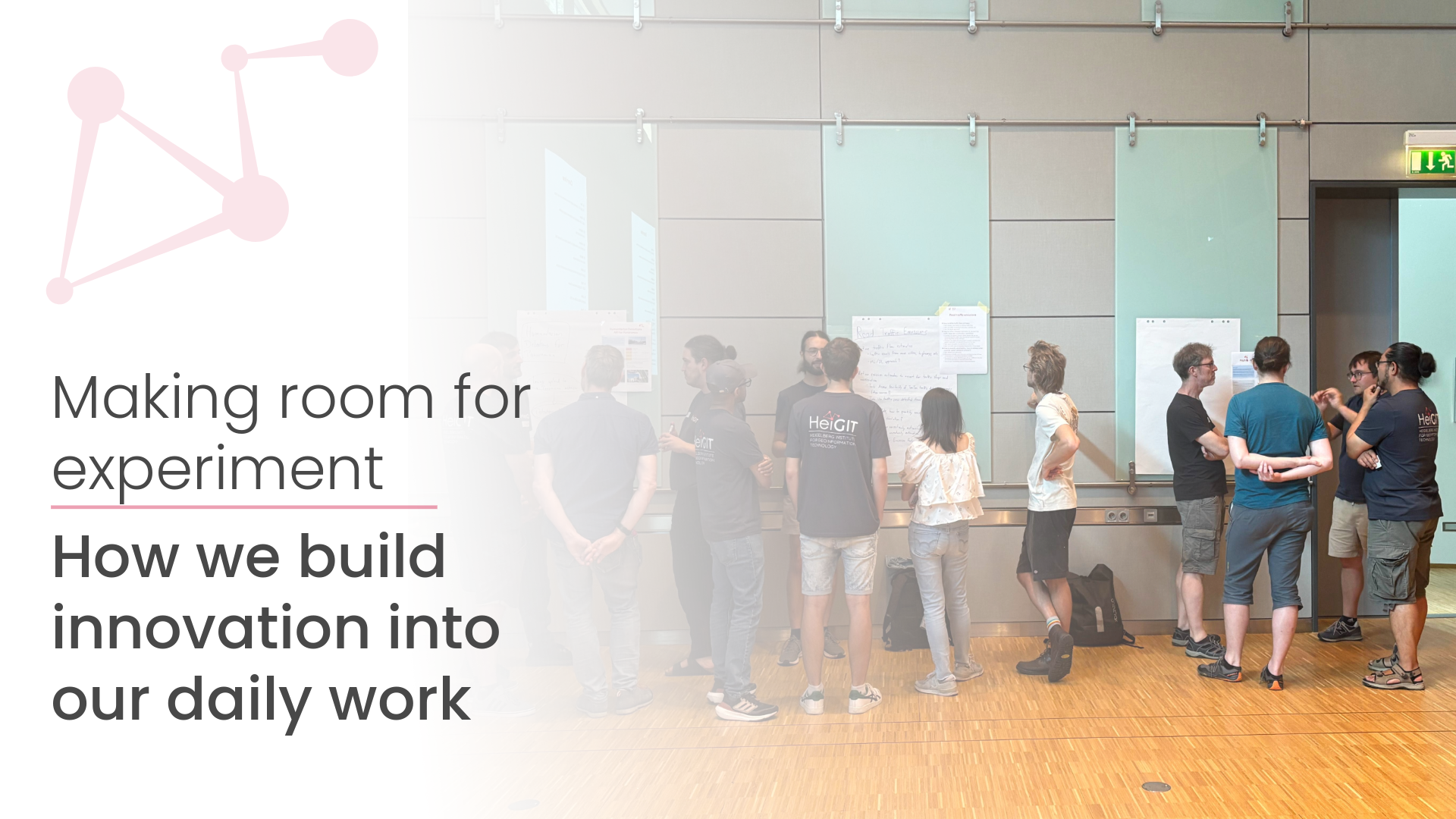
In recent years, HeiGIT has dedicated time to experimenting with new ideas, technologies, and collaborations, free from the immediate pressure to deliver results. What started as a new experience has become an established activity, highlighting our growth as an institute and our commitment to curiosity and innovation.
As our tools grow more advanced and our partners rely on them, much of our time goes to maintenance, adding features, and daily tasks. Without setting aside time to experiment, it is hard to try new ideas, apply scientific knowledge, and prepare for the next generation of tools.
How Innovation Weeks Started at HeiGIT
Innovation weeks were introduced to give everyone at HeiGIT a structured opportunity to share their own ideas, form teams and explore them beyond regular project responsabilities. From the start, the goal behind Innovation Weeks was simple but effective: take a short break from regular project work and try something new, even if it might not succeed. Topics were deliberately broad, and ideas came from across HeiGIT and GIScience, leading to a wide range of creative projects.
This idea builds on earlier experiences at HeiGIT, where giving teams time and freedom to experiment led to successful tools such as MapSwipe and the Sketch Map Tool.
HeiGIT held its first Innovation Weeks in September 2023, organized by Johannes Link and supported by Adam Rousell. Two more Innovation Weeks took place in November 2023. By 2024, the format was well established, with events in April, July, and October. Management and the organizing team set fixed dates for Innovation Weeks. This gave structure and made the event visible, but it also brought some challenges. Some colleagues could not join and would feel stressed because they had urgent projects that could not be delayed.
This year, Benjamin Herfort and Johannes Link organized Innovation Summer together. They used what they learned from past years and adjusted the format to better align with HeiGIT’s growing, more diverse work environment. Instead of set weeks, teams could choose any time between July and September to work on their innovation topic, for up to two weeks each. This made it easier for people to take part, but it also meant teams had to plan more carefully to balance innovation with other deadlines.
Innovation does not mean immediate implementation
A core idea behind Innovation Weeks and Innovation Summer is that not every idea has to be put into action. This is important because innovation thrives when people can try out new ideas beyond their usual work, without feeling pressured to turn every experiment into a final product.
It is often hard to know which ideas will last. Looking back, some innovation topics from 2023 and 2024 are only now, years later, starting to be used in practice.
Some examples are:
- Vector Tiles (Proxy) were explored during an Innovation Week in 2024 and will soon be available in the Climate Action Navigator. At that time, there were many ideas but no concrete plans. Innovation Weeks gave us the chance to explore the technology and see its potential.
- OSM-aware LLMs were explored in July 2024. This sparked ongoing discussions and now shapes the work of HeiGIT’s research team.
- Accelerating Geospatial Data Science with DuckDB and Parquet Files, which happened in April 2024, laid the groundwork for efficiently analyzing large datasets. Today, DuckDB is widely used at HeiGIT.
Innovation Summer often felt a bit hectic, but in a good way. Many colleagues looked forward to these times because they could finally work on their own ideas rather than just follow project requirements set by Product Owners. This excitement and motivation are a big reason why innovation works at HeiGIT.
Why should Innovation Weeks become a regular part of our work?
Management first decided to introduce Innovation Weeks to ensure HeiGIT continues exploring new approaches and technologies, rather than just maintaining existing tools. As HeiGIT has grown and tools like MapSwipe, Sketch Map Tool, and openrouteservice are used by many partners, a new challenge has come up: maintenance and feature development can easily take up all our time.
If we do not set aside time for innovation, these tools could become outdated. Innovation Weeks help address this problem by providing space to balance research freedom with the responsibility to deliver reliable software for humanitarian aid and climate action.
In 2015, HeiGIT was free to build the first MapSwipe prototype. The first Sketch Map Tool was also developed in a research project that allowed a lot of flexibility and experimentation. Innovation Weeks are meant to keep some of that freedom, even as our work becomes more structured and focused on providing sound technology.
By making Innovation Weeks official and setting clear guidelines, colleagues got both permission and time to try new things. This turned the general wish for innovation into a lasting practice at HeiGIT.
What does a “successful” outcome look like?
There are no KPIs or instant success metrics, and that’s by design. Two weeks is simply too short a time to know whether an idea will succeed.
Success can mean many things, such as:
- High participation and motivation from different teams
- Collaboration between colleagues from different teams who do not often work together
- Planting early seeds for research papers, new software features, partnerships, or funded projects
Often, it takes two or three years before we see the real impact of an innovation topic.
In the future, innovation formats may continue to evolve: new spaces, external collaborators, or broader learning focused themes could help spark fresh ideas.
In the end, Innovation Weeks and Innovation Summer are about asking one simple but important question: What will be the MapSwipe or Sketch Map Tool of 2025, and what will we be proud of in 2030?
Making room to explore this question is what keeps HeiGIT innovative.