The 16th International Conference of the Integrated Disaster Risk Management (IDRiM) 2026 brings together experts from research, practice, policy, and civil society to advance integrated approaches to disaster risk management. Taking place in Bali, Indonesia, under the theme “Resilient Cities in Multi-Hazard Crises: Bridging Innovation, Implementation Science, and Grassroots Action,” the conference highlights innovative solutions and practical approaches for building resilient communities.
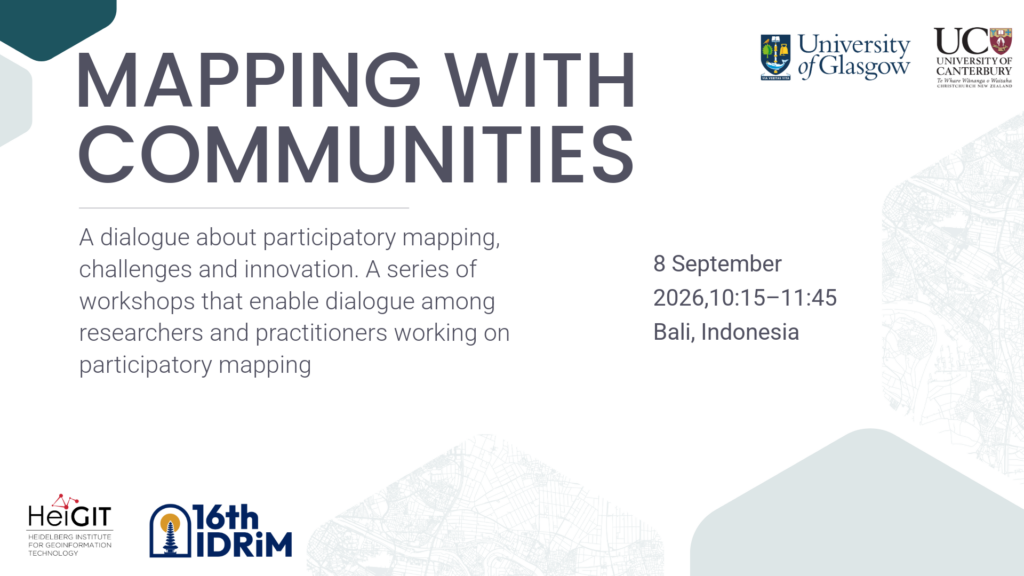
This year, the Mapping with Communities series is coming to IDRiM. Co-organized by HeiGIT, the Urban Big Data Centre (UBDC) at the University of Glasgow, and the University of Canterbury, the special session brings together experiences from different regions to explore how community mapping can strengthen disaster risk management by connecting local knowledge, participatory approaches, and digital tools.
HeiGIT will also co-organize a special session on meaningful community engagement in Anticipatory Action together with the University of Glasgow and the University of Canterbury. In addition, Anne Schauss will give an oral presentation on open-source approaches to decentralized risk assessment.
The full conference program is available here.
Mapping with Communities
8 September 2026, 10:15–11:45
Organizers: Anne Schauss, HeiGIT, DE, Anne.Schauss@heigit.org, Diego Pajarito Grajales, Urban Big Data Centre, University of Glasgow, UK, Diego.PajaritoGrajales@glasgow.ac.uk, Carolynne Hultquist, School of Earth and Environment at the University of Canterbury, NZ, Carolynne.Hultquist@canterbury.ac.nz.
Top-down disaster risk management (DRM) has proven insufficient for complex risk scenarios. There are constant calls to integrate local knowledge into early warning systems (Hermans T. et al, 2022). Community mapping (CM) is an effective sustainability strategy to enable dialogue, strengthen engagement, localize knowledge and understand risks spatially.
Despite having such a potential, CM’s impact in DRM is often limited by critical challenges: a) grassroots knowledge remains isolated unless it can be translated into digital interoperable resources trusted by decision-makers, and b) Community maps remain seen as local geographic data repositories and not yet as tools to foster situational awareness, spark vital discussions, and help gain trust and build resilience. We plan this workshop as a learning space for all to learn about PM through case studies, existing challenges, as well as related digital innovation and concepts of data fairness and digital sovereignty.
Meaningful Community Engagement in Anticipatory Action
8 September 2026, 15:45–17:15
Organizers: Anne Schauss, HeGIT, DE, Anne.Schauss@heigit.org, Diego Pajarito Grajales, Urban Big Data Centre, University of Glasgow, UK, Diego.PajaritoGrajales@glasgow.ac.uk, Carolynne Hultquist, School of Earth and Environment at the University of Canterbury, NZ, Carolynne.Hultquist@canterbury.ac.nz.
Participatory methods (PM) are well known in social sciences and humanitarian work. When adopted in Anticipatory Action (AA), they are highly prone to treating communities as passive data sources rather than fostering mutual exchange. AA must engage communities as co-producers and active co-designers at every stage of the operational continuum. We argue that a shift towards co-production can lead to localized, just and less instrumental interactions on the one hand, and to a better integration of local knowledge systems into risk management strategies. Recognizing the gap between research and practice of PM, our session asks: How can communities be more closely engaged to ground AA in local needs? How does this strengthen collaboration across multiple actors? We plan this session to explore innovative engagement, from intentional monitoring to local knowledge exchange to investigate localized AA, existing challenges, as well as related digital innovation and concepts of data fairness.
Oral Presentation: Decentralizing Risk Assessments through Open-Source Tools
9 September 2026 | 10:15–11:45
Presenter: Anne Schauss