
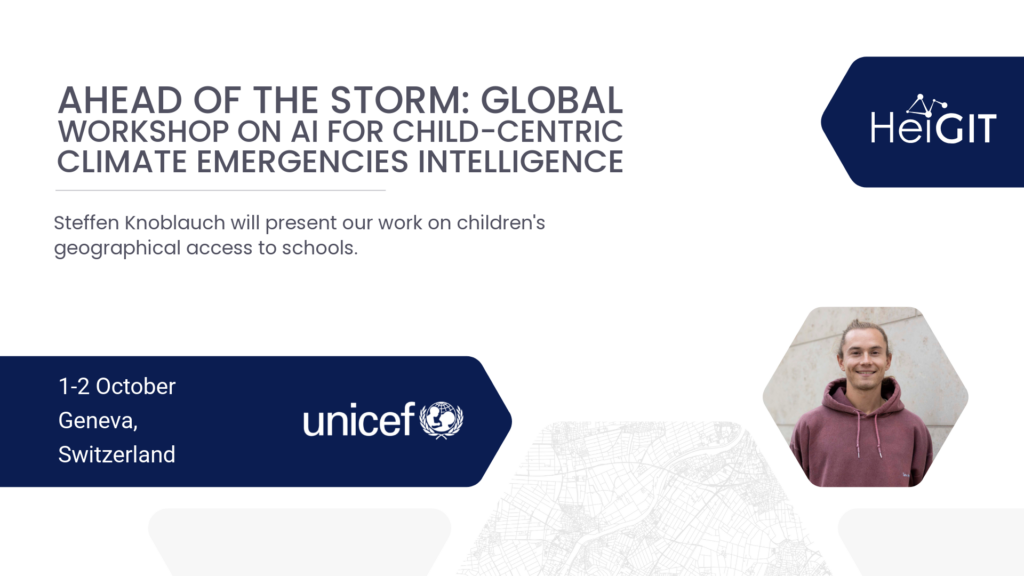
The Ahead of the Storm Global Workshop will take place from 1–2 October 2026 at the Centre International de Conférences Genève in Geneva. The UNICEF AI Office and the Government of Spain co-host the workshop, with support from the Government of Switzerland.
Ahead of the Storm is an initiative to accelerate the development and operational use of child-centric AI and frontier data technologies in climate emergencies. It covers the period from the first forecast of a hazard until the hazard has passed, including early warning, anticipatory action, emergency response, and the first stages of early recovery.
The workshop brings together around 50 field practitioners, AI experts, scientific and weather institutions, and national and global champions to identify gaps, set shared priorities, and develop practical solutions. HeiGIT will present its work on children’s geographical access to schools and how it overlaps with exposure to climate hazards.
Presentation: Children’s geographical access to schools
Authors: Marcel Maurer, (presenter) Steffen Knoblauch
Access to education is fundamental to children’s development, but global differences in how far children live from school remain poorly understood. Steffen Knoblauch and Marcel Maurer mapped how far children live from the nearest school worldwide and found that 623 million children, about one in three, live more than 10 km from a mapped school. Countries with lower human development generally fare worse. However, the best-performing low-HDI countries outperform the weakest high-HDI countries, so development level alone does not predict access. In cities, access to schools differs little between countries. In rural areas, the differences are large, and the rural–urban gap is widest in countries at intermediate levels of development. The children who live farthest from schools are often the same children most exposed to multiple climate hazards. Our subnational analysis shows where these disadvantages overlap. This helps education, transport, and emergency planners focus support where missing schools and roads most limit progress toward SDG 4 and where children are most at risk in climate emergencies.