
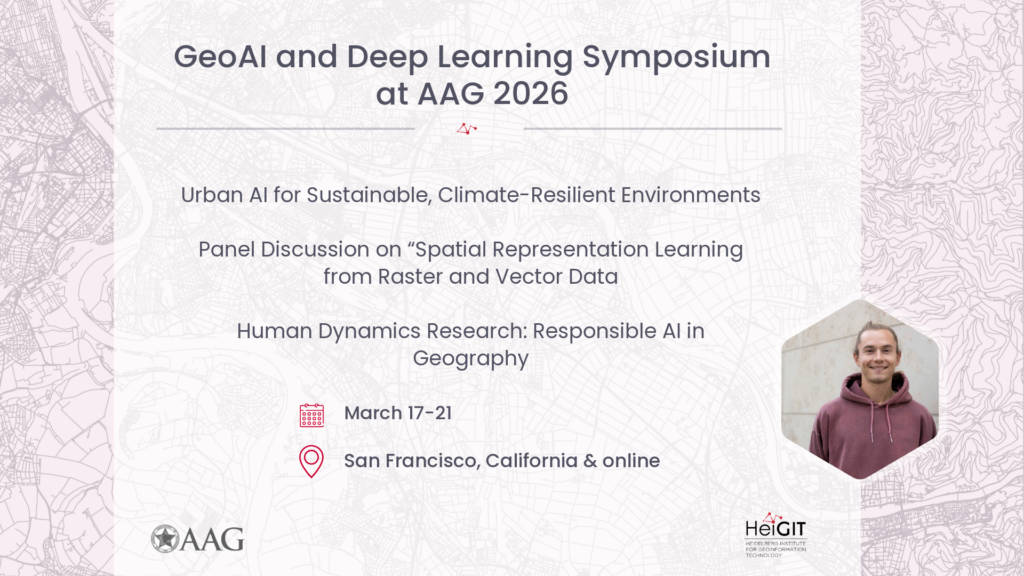
The field of GeoAI is advancing at an astonishing speed. We are excited to witness the significant growth of GeoAI in terms of its methods, its diverse geospatial applications, and its increasing societal impacts. For example, GeoAI has been applied to advance our understanding of the earth’s environment and climate change, improve individual and population health, enhance community resilience to natural disasters, strengthen smart and connected communities, more accurately predict spatiotemporal traffic flows, support humanitarian mapping and policymaking, and more. From a methodological perspective, we have observed a paradigm shift from using task-specific models with supervised learning to leveraging the power of visual foundation models, large language models (LLMs), and multimodal foundation models to enable zero-shot to few-shot geospatial learning. We have also seen an increasing body of pioneering research integrating spatial theories and principles into general AI model design to develop “spatialized” AI that best tackles spatial and spatiotemporal problems.
Building on the success of previous AAG GeoAI symposiums and continuing to push the cutting edge of GeoAI research and its societal impact, the 2026 symposium aims to bring together geographers, GI scientists, remote sensing scientists, computer scientists, health researchers, urban planners, transportation professionals, disaster response experts, ecologists, and earth system scientists, stakeholders, and many others to share recent research outcomes and discuss challenges for GeoAI research in the following years.
GeoAI and Deep Learning Symposium: Urban AI for Sustainable, Climate-Resilient Environments
March 17; 12:50 – 2:10 pm; Peninsula, 25th floor, Nikko
UrbanAI holds the potential to reshape how cities tackle sustainability and resilience by merging artificial intelligence, spatial computing, and urban science to address pressing climate-related challenges. With rising temperatures and increasing extreme weather events worldwide, cities face unique demands, especially in managing vital resources such as water, energy, and land use. AI-powered solutions offer innovative pathways for sustainable development and climate adaptation. By leveraging vast environmental and urban datasets, UrbanAI can enable near real-time monitoring of critical climate indicators – such as air quality, urban heat, and flood risks – empowering cities to implement proactive measures that enhance resilience and public well-being in the future. This session welcomes research on diverse applications of UrbanAI for climate resilience.
Organizers: Steffen Knoblauch (Heidelberg University), Hao Li (National University Singapore), Gengchen Mai (University of Texas at Austin), Yingjie Hu (University at Buffalo), Wenwen Li (Arizona State University), Filip Biljecki (National University Singapore)
GeoAI and Deep Learning Symposium: Panel Discussion on “Spatial Representation Learning from Raster and Vector Data”
March 18; 8:30 – 9:50 am; Bay View, 25th floor, Nikko
This panel discussion brings together experts from machine learning, computer vision, geoinformatics, and Earth sciences to explore the frontiers of spatial representation learning using both raster and vector data. As Earth observation (EO) data becomes increasingly multimodal and large-scale, and as general-purpose foundation models like AlphaEarth (DeepMind), Terramind (IBM-ESA), Earth System (AllenAI), and DINOv3 (Meta) emerge, we face both exciting opportunities and complex challenges in building robust, interpretable, and scalable models for understanding our planet.
This panel will center on the following questions:
What are promising applications where EO foundation models could be effectively combined with vector data?
What are standout downstream tasks for which vector data is particularly well-suited?
Is it worthwhile to develop embeddings that capture vector geometries and spatial relations?
What are the advantages and limitations of translating human-intuitive 2D/3D spatial relationships into high-dimensional embedding spaces? How do deep learning approaches for vector embedding compare to traditional spatial analysis methods?
Moderator:
Steffen Knoblauch (Heidelberg University)
Panelists:
Wenwen Li (Arizona State University), Song Gao (University Wisconsin-Madison), Gengchen Mai (The University of Texas in Austin), Xinyue Ye (The University of Alabama)
GeoAI and Deep Learning Symposium: Human Dynamics Research: Responsible AI in Geography
March 19; 2:30 – 3:50 pm; Continental 8, Ballroom Level, Hilton Union Square
Artificial Intelligence (AI) is rapidly transforming the ways how geographers map, study, perceive, and engage with the place and environment across the world. Living in a changing climate, the integration of AI into geographical research and practice sheds promising lights in fostering sustainability, resilience, and equity at scale. For example, AI-based geographic technologies, such as climate risk models, disaster response systems, or urban environment monitoring, can produce accurate, timely, and actionable insights, but if developed or deployed irresponsibly, they may result in widening spatial inequalities, misrepresenting marginalized communities, and generating unsustainable environmental costs, etc. In this context, Responsible AI plays a vital role when integrating AI in geographical tasks, where the ethics, fairness, inclusivity, and responsibility of AI systems matters.
Organizer: Hao Li (National University of Singapore), Steffen Knoblauch (Heidelberg University), Xintao Liu (Hong Kong Polytechnic University)
For more information, click here.