
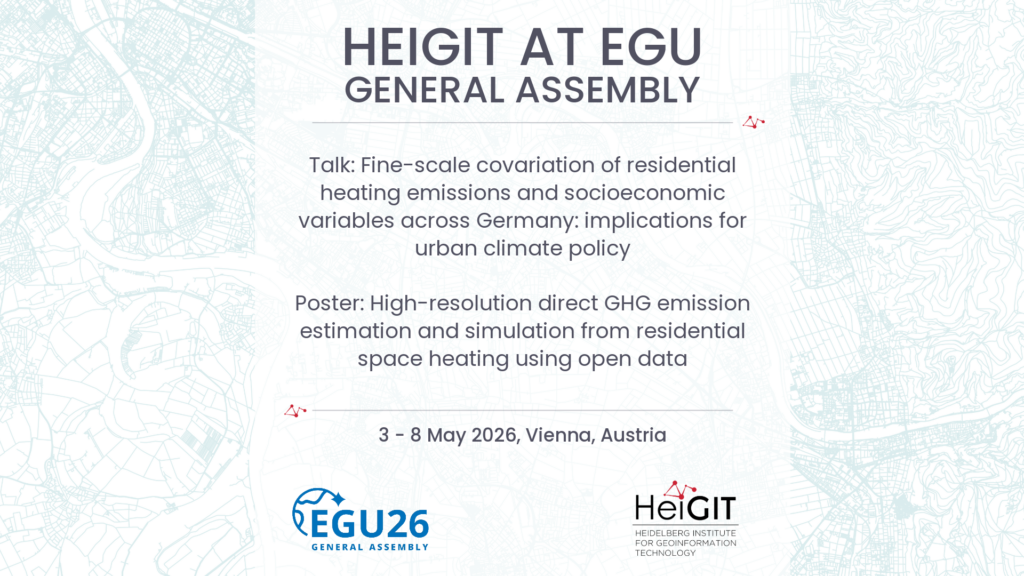
The EGU General Assembly is the main annual conference for the geoscience community. It brings together researchers from around the world to share and discuss new developments in Earth, planetary, and environmental sciences. This year, the conference will be held from 3 to 8 May 2026 in Vienna, Austria. Our colleagues will give a talk about how residential heating emissions and socioeconomic factors are linked across Germany, with a focus on what this means for fair urban climate policy. They will also present a poster about the Climate Action Navigator, an open-science platform that helps estimate and simulate greenhouse gas emissions from residential heating in high detail.
Talk: Fine-scale covariation of residential heating emissions and socioeconomic variables across Germany: implications for urban climate policy
Tuesday, 05 May, 10:45–10:55 (CEST) Room D3
Speakers: Sebastian Block, Veit Ulrich, Gefei Kong, Maria Martin, and Kirsten von Elverfeldt
Residential heating is a large source of greenhouse gas emissions and a priority for urban climate change mitigation efforts. However, effective planning of decarbonization policies is hampered by the lack of fine-resolution emission estimates at sub-city scales. Such spatially disaggregated data are essential for analyzing how emission patterns co-vary with important social, economic, and demographic characteristics within cities, which is needed for designing targeted and equitable policy interventions.
We use high-resolution population and building data from the 2022 German census to estimate carbon dioxide emissions from residential buildings across Germany. We then explore how emission patterns covary with socioeconomic and demographic variables relevant for policy design.
Our analysis reveals significant spatial heterogeneity in per capita emissions within cities. We find that areas with higher rates of home ownership exhibit elevated per capita emissions, suggesting these neighborhoods represent prime targets for building renovation incentives directed at homeowners. Additionally, we observe higher per capita emissions in areas with larger proportions of senior residents (>66 years old), who typically consume more energy for heating. This pattern indicates that high-emitting buildings (larger, older buildings heated with carbon-intensive energy carriers) tend to spatially overlap with populations likely to have intensive heating behaviors, potentially compounding resulting emissions.
These findings underscore the importance of analyzing urban carbon dioxide emission patterns at fine spatial scales and examining their spatial correlation with relevant socioeconomic and demographic characteristics. Our analysis reveals sub-city emission patterns with clear implications for policy design. Effective decarbonization strategies must account for these spatial patterns to plan interventions that account both for building infrastructure and occupant characteristics, ensuring efficient resource allocation and equitable climate action across diverse urban settings.
Poster: High-resolution direct GHG emission estimation and simulation from residential space heating using open data
Display time: Fri, 8 May, 14:00–18:00, X5.90
Presenters: Kirsten v. Elverfeldt, Gefei Kong, Veit Ulrich, Maria Martin, Moritz Schott, and Sebastian Block
Residential space heating remains a major source of greenhouse gas emissions in the building sector. In Germany, space heating accounts for the largest share of residential energy consumption, and accurate quantification of associated emissions is essential to meet national climate mitigation targets.
Most research on residential heating emissions focuses on the regional or national levels, while estimates at finer spatial scales remain limited. Data availability further constrains the transferability and usability of current models. Consequently, approaches that deliver spatially and temporally detailed emission estimates and interactive tools to support analysis and decision-making by stakeholders are urgently needed.
We introduce the Climate Action Navigator (CAN), a dashboard for the analysis and visualization of climate mitigation and adaptation spatial data, based entirely on open science principles. One of the tools available in the CAN estimates carbon dioxide emissions from residential heating at fine spatial at temporal scales. The tool applies a bottom-up accounting methodology at 100 m spatial resolution based on publicly available census and building characteristics data in Germany, including building age and dominant energy carriers. The resulting emission estimates are consistent with official city- and national-level inventories, confirming methodological reliability. Germany-wide analyses reveal strong spatial heterogeneity in energy consumption and emissions that correlate with urban morphological characteristics.
Temporal dynamics are captured through an hourly simulation using the Demand Ninja model based on local weather data. The resulting temporal emission patterns can support inverse emission modelling applications as well as aid energy management by, for example, revealing peak heating demand times and locations.
Results are delivered via the CAN interface as intuitive, interactive maps and charts that allow users to compare across neighborhoods, explore temporal emission dynamics, and assess potential mitigation actions. By integrating open-source data with high-resolution modeling and visualization, the Climate Action Navigator bridges the gap between scientific emission quantification and practical decision making. The approach supports transparent attribution and tracking of residential space-heating emissions, thereby advancing evidence-based climate mitigation planning.