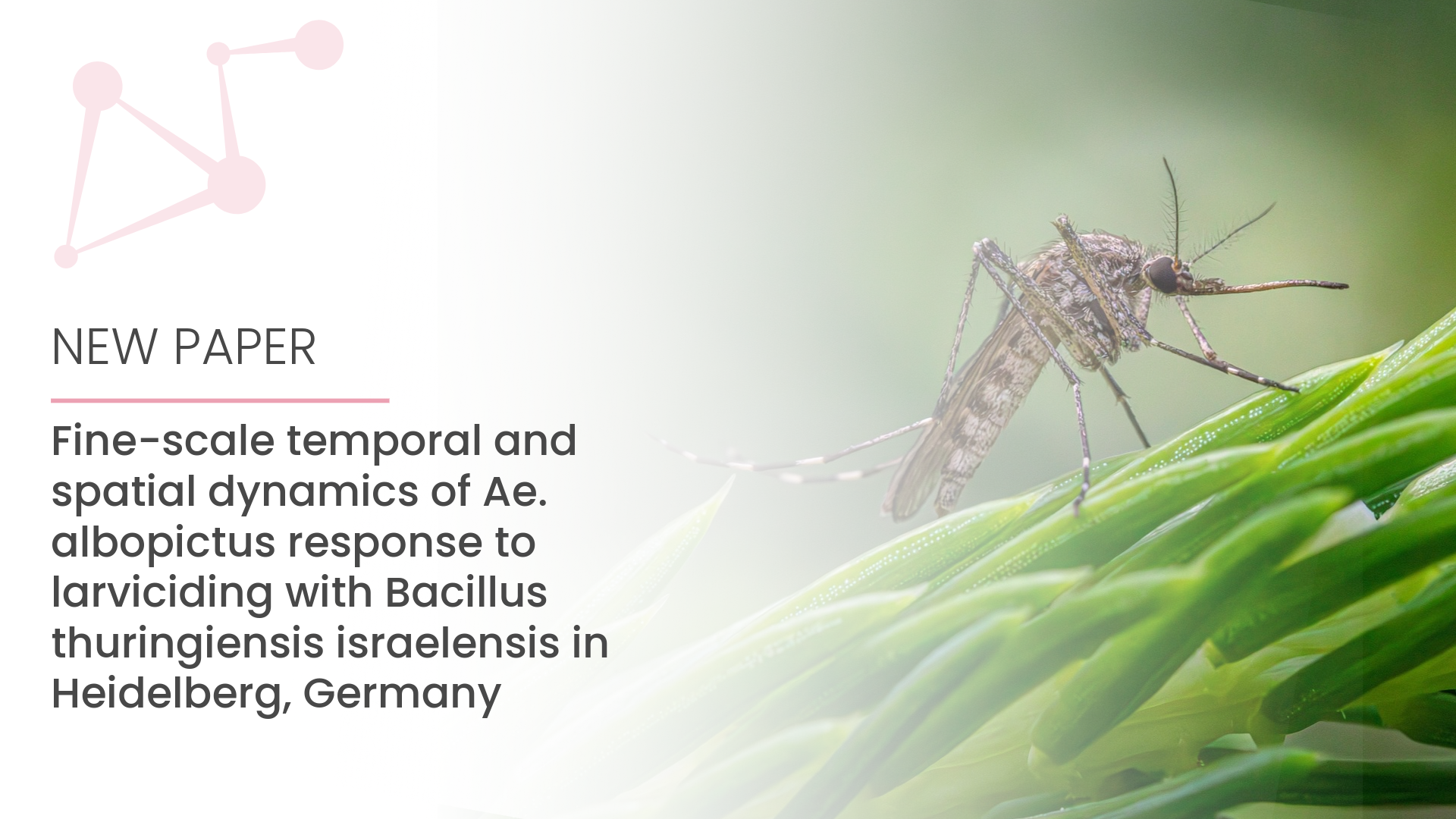
The study focuses on Heidelberg, Germany. There, the Asian tiger mosquito poses a growing public health concern as it spreads through Europe. Because this mosquito transmits viruses such as dengue and chikungunya, researchers must test how well control methods work in real-world conditions.
Instead of just testing if Bti works in theory, the study asks how long its effects really last in the field. To find out, the team combined mosquito monitoring, records of larvicide (Bacillus thuringiensis israelensis or Bti) use, and collected local environmental data from the 2023 mosquito season in Heidelberg. They recorded 1,320 ovitrap (egg-laying trap) observations from 195 traps and tracked 4,387 Bti treatments to closely follow mosquito patterns.
The results show that Bti substantially reduced mosquito egg counts overall, but the strongest effect lasted only to short- to mid-term after treatment. The biggest drops in egg counts happened about 6 to 13 days after Bti was applied. The effect faded after that, especially with fewer treatments. When more treatments were used, the effect lasted longer, up to about 28 days. Bti works, but it is not a one-time fix. Regular and well-timed treatments are still needed.
Over the whole season, the impact proved significant. Modeling indicates that Bti treatments cut total seasonal egg production by about 41.9%. Without these treatments, mosquitoes would likely have spread across the entire study area. In the actual data, eggs appeared in about 70.8% of traps. The no-treatment scenario showed eggs would have appeared in all 195 traps at least once. The interventions not only reduced numbers but also likely limited the mosquitoes’ spread in the city.
The study also shows that mosquito activity can vary a lot within a city. The analysis found clear hotspots in the urban centers of Pfaffengrund, Kirchheim, and Rohrbach, with Pfaffengrund showing the strongest spatial effect. Weather played a role, too. Egg counts went up with warmer temperatures, especially above 20°C. Counts also increased with rainfall up to about 10 mm before leveling off. These results show that mosquito control depends not just on treatments, but also on local environmental and spatial factors.
The paper applies a distributed lag non-linear modeling approach, showing how an outcome changes both with time since an event and with the amount of exposure, using high-resolution mosquito control data. This approach lets researchers observe delayed effects over time, instead of assuming treatment works immediately or in the same way each time. This distinction is important for larvicides like Bti, which target mosquito larvae and not adults. By linking the timing of treatment applications, local environmental conditions, and egg counts, the study provides a clearer picture of how control measures operate in real urban settings.
Overall, the paper presents strong evidence that Bti effectively controls Aedes albopictus in cities. It also highlights Bti’s limits over time. The findings underline the importance of repeated, well-timed, and spatially targeted interventions for mosquito control.
Reference: Hatfield, C.R.S., Stiles, P.C., Liyanage, Baron, PJ..N., Tokatlian Rodriguez, A., Becker, N., Zipf, A., Beigl, M., & Rocklöv, J. (2026). Fine-scale temporal and spatial dynamics of Ae. albopictus response to larviciding with Bacillus thuringiensis israelensis in Heidelberg, Germany. Scientific Reports, 16, 12031. https://doi.org/10.1038/s41598-026-46094-9