Hidden Energy Poverty (hEP) represents an underestimated form of energy vulnerability in which households consume less energy than required to achieve adequate indoor thermal comfort conditions. This phenomenon is particularly relevant in contexts characterized by high energy prices and housing stocks with poor thermal performance, where economic constraints lead to deliberate reductions in energy consumption that do not necessarily reflect energy-efficient dwellings or adequate access to energy services. As a result, a considerable proportion of vulnerable households remain outside the scope of conventional energy poverty metrics.
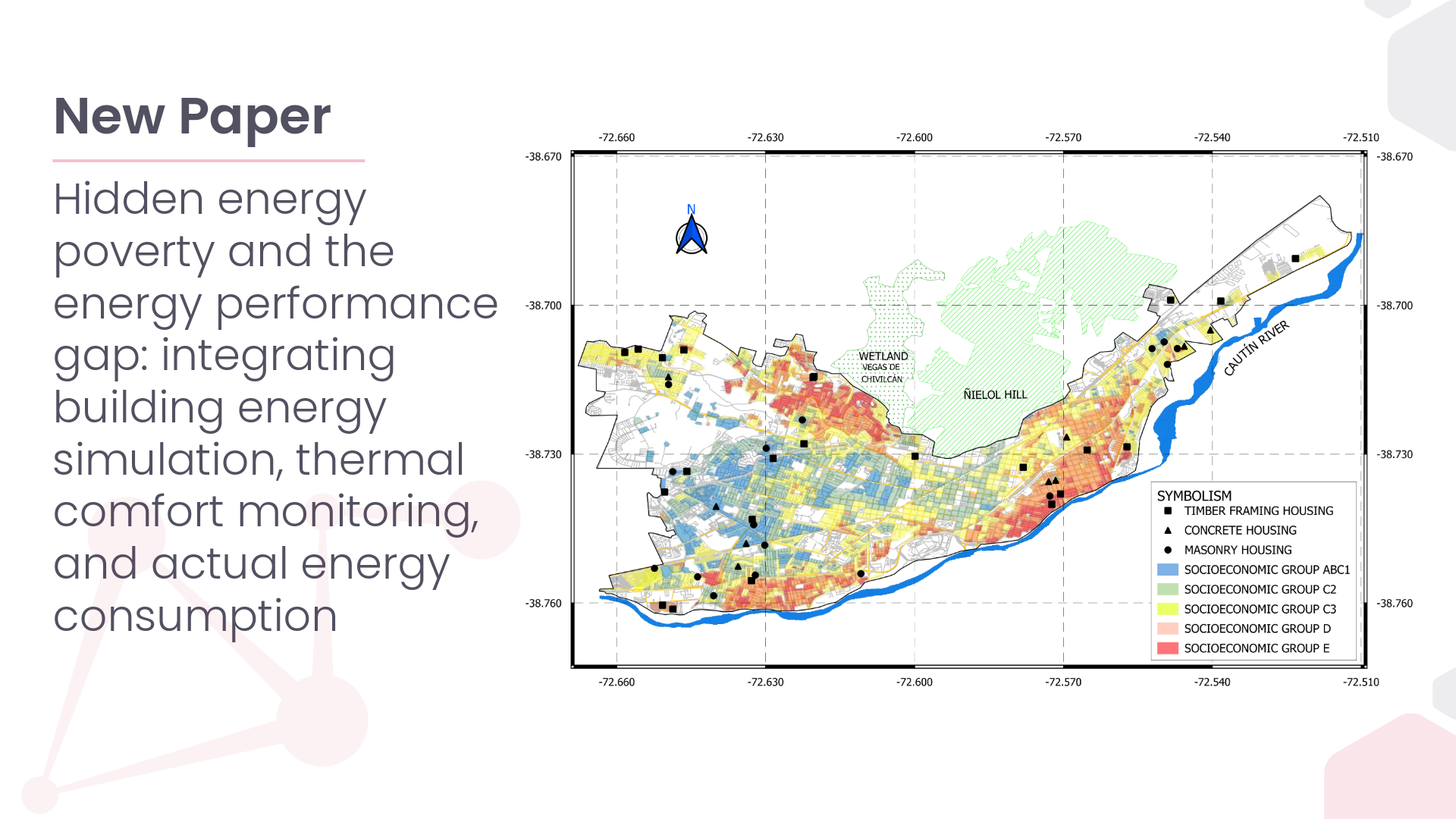
This study identifies and quantifies hidden energy poverty through a building-performance-focused approach, evaluating 53 urban dwellings in Temuco, Chile, via energy simulations, year-long continuous indoor temperature and humidity monitoring, and surveys of actual household energy consumption.
The results showed that more than half of the analyzed dwellings (53%) exhibited an “energy deficit,” meaning that they consumed significantly less energy than required to maintain healthy indoor thermal conditions. In this context, one of the most relevant findings was that nearly 45% of the dwellings remained outside adequate temperature and humidity ranges for more than one-third of the year, while 11% spent more than 60% of the time under indoor conditions considered inadequate for human well-being.
In addition, the study identified important differences associated with housing construction quality and household socioeconomic level. Based on these findings, improvements to traditional energy poverty indicators were proposed by incorporating dimensions related to energy consumption deprivation and prolonged exposure to thermal discomfort, aspects that have remained largely invisible in methodologies based solely on household energy expenditure, a phenomenon defined as “hidden energy poverty.”
Reference: Martinez-Soto, A., Castro-Coliqueo, K., Sanhueza-Catalán, D., Reyes-Riveros, A., & Zipf, A. (2026). Hidden energy poverty and the energy performance gap: Integrating building energy simulation, thermal comfort monitoring, and actual energy consumption. Energy and Buildings, 117669. https://doi.org/10.1016/j.enbuild.2026.117669