Anticipatory Action (AA) has become a central pillar of contemporary humanitarian action. Its goal is to lessen the effects of climate related hazards by enabling preventive steps before crises fully materialize, based on forecast based decision-making and early warning data such as food insecurity projections implemented in trigger systems. During droughts, food insecurity projections are especially important because they enable the identification of emerging crises several months in advance and guide early action.
But what happens when practitioners need to choose between two widely used food insecurity projection systems, or suddenly substitute one for another? This question became especially relevant after recent USAID funding disruptions and the temporary shutdown of FEWS NET, which highlighted the vulnerability of critical humanitarian data streams. For anticipatory action systems, switching the data source can create uncertainty in established trigger systems and may change the timing of early actions.
FEWS NET and the Integrated Food Security Phase Classification (IPC) are two internationally operating systems that provide widely used assessments and projections of acute food insecurity. Both use a compatible five-class Acute Food Insecurity classification scale, but they differ in methods, how often they release data, the areas they cover, and their assessment and projection cycles. These differences can make it challenging for practitioners to design effective anticipatory action trigger systems.
A comparison of FEWS NET and IPC in Somalia
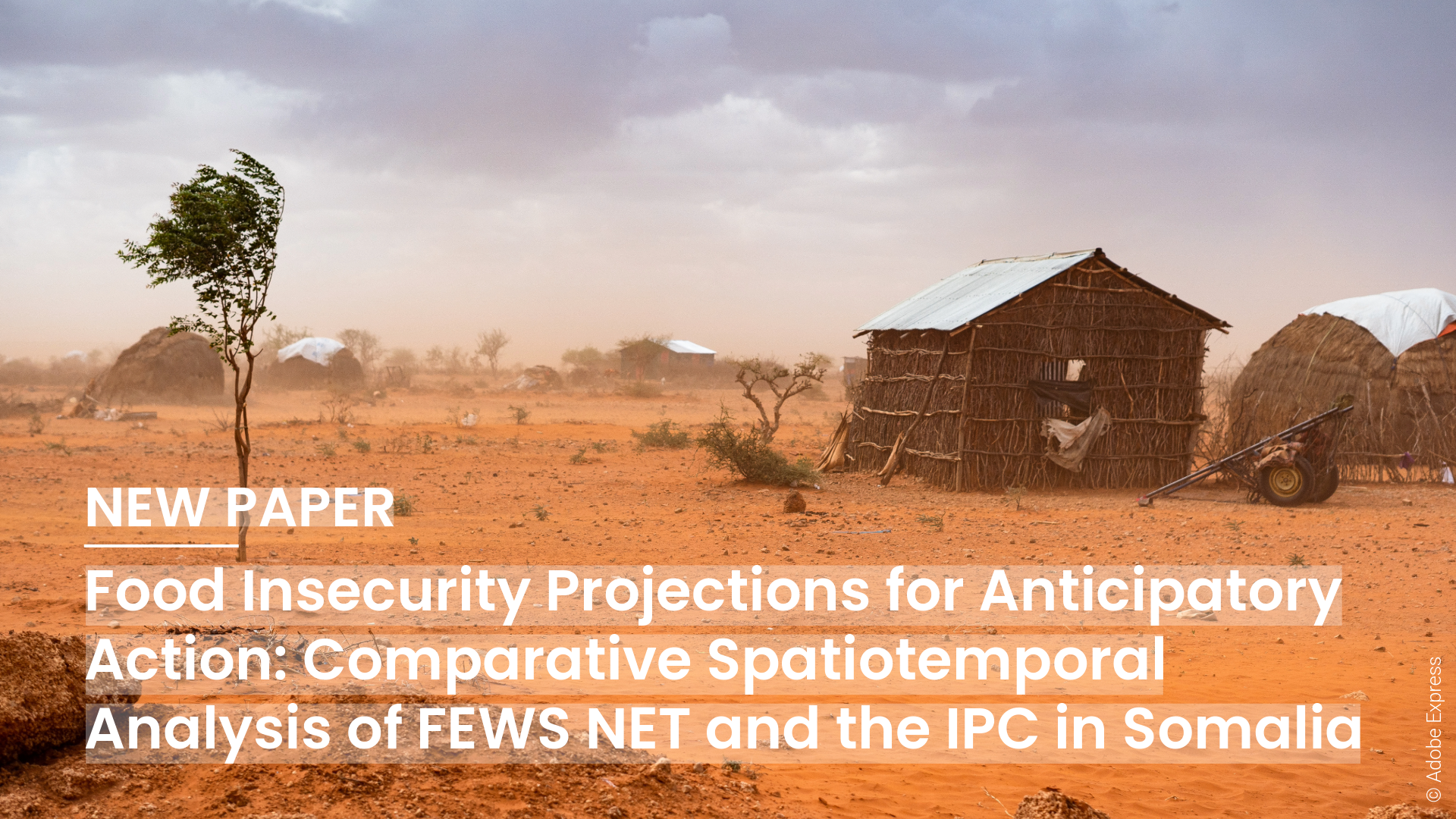
This study systematically compares FEWS NET and IPC food insecurity data for Somalia from 2017 to 2025. By using harmonized geospatial time series, the authors evaluate differences in historical assessments and projections, how often crisis conditions are projected, and how accurate these projections are compared to later assessments. Somalia was chosen as the case study because it has faced recurrent and severe droughts in the past decade, often made worse by conflict and economic challenges. These ongoing crises make anticipatory action essential and provide a suitable context for evaluating how the two systems perform in both stable and crisis situations.
How do the systems differ?
The results show that FEWS NET and IPC current assessments are very consistent over time and across locations. Throughout the study period, the average food insecurity values in current assessments were nearly identical across both systems. However, the projections showed more differences. FEWS NET tended to project higher levels of food insecurity than IPC, especially with more frequent Emergency and Famine conditions.
This matters for anticipatory action because these severe categories often trigger early action protocols. For example, if ‘Emergency’ status is used as a trigger, FEWS NET-based thresholds would have potentially triggered considerably more often than IPC during 2017 to 2025. So, any change between systems should be carefully considered, as it can significantly affect how triggers work.
What are the implications for anticipatory action?
The comparison found that both systems had moderate accuracy in their projections, with FEWS NET at 61.8% and IPC at 64.5% agreement between projections and later assessments. For both systems projection errors displayed a tendency to underestimation in the low classes and to overestimation for high projected food insecurity. This reflects a precautionary forecasting tendency, where overestimation can reduce the risk of missed crises, but may also increase the likelihood of premature or unnecessary action.
Overall, the study shows that FEWS NET and IPC projections cannot be used interchangeably, even though they use the same classification scale. The choice of dataset can substantially influence how often triggers are activated and how responses are planned.
Reference: Seyffer, F., Schauss, A., Tirai, S., Maurer, M., Lautenbach, S., & Zipf, A. (2026, June 10). Food Insecurity Projections for Anticipatory Action: Comparative Spatiotemporal Analysis of FEWS NET and the IPC in Somalia. AGILE GIScience Series, 7, 17. https://doi.org/10.5194/agile-giss-7-17-2026