Recent Global Burden of Disease reports analyze health risks associated with alcohol consumption, indicating that policy attention should shift toward reducing everyday exposure. While spatial restrictions on alcohol sales are a known policy lever, existing exposure measures often map outlet presence rather than behaviorally plausible purchase opportunities along routine trips. This paper, presented at AGILE 2026, introduces a behaviorally informed, detour-based index of alcohol exposure tailored to same-day after-work purchases. The research investigates how empirical detour budgets derived from survey data in two German cities can be used to identify feasible purchase opportunities on walking paths and simulate alternative retail regimes.
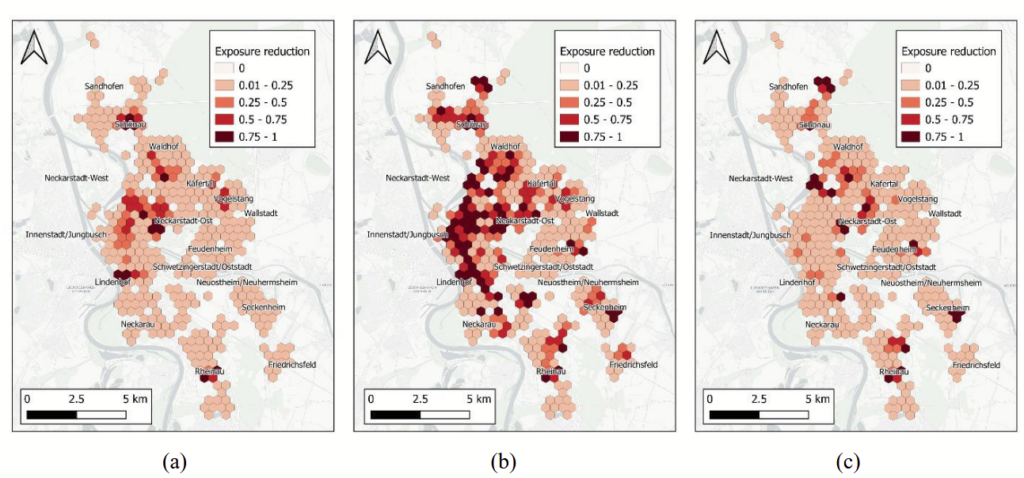
The authors conducted an online survey among adults in the German cities of Mannheim and Heidelberg to infer empirical detour budgets for after-work alcohol runs. These budgets are embedded in an index that captures the share of transit–home walking paths, including feasible purchase opportunities and a store-level leverage index. Under a 250 meters detour budget, approximately 50% of stop–home walking segments are exposed. Kiosks represent 28% of outlets, but account for roughly 35% of after-work leverage. Policy simulations indicate that a state retail monopoly cuts mean home exposure by about 75%, while targeted removal of the 25% most exposure-imposing outlets achieves almost the same reduction as a selective licensing pattern that shuts more stores.
The findings demonstrate how behaviorally informed exposure metrics can support more targeted alcohol-availability policy by identifying which outlets matter most for specific routines. The study notes limitations, including a reliance on a small convenience sample and stylized regulatory abstractions. Despite these constraints, the approach offers a template for linking spatial exposure measurement to concrete policy design. The authors conclude that behaviorally informed detour-based metrics capture exposure patterns that static outlet density misses, laying the groundwork for more precise, path-oriented policy design beyond outlet counts.
Reference: Fulman, N., Memduhoğlu, A., Huber, J., & Zipf, A. (2026). Detour-based metrics of alcohol availability along walking commutes, AGILE GIScience Ser., 7, 23. https://doi.org/10.5194/agile-giss-7-23-2026