
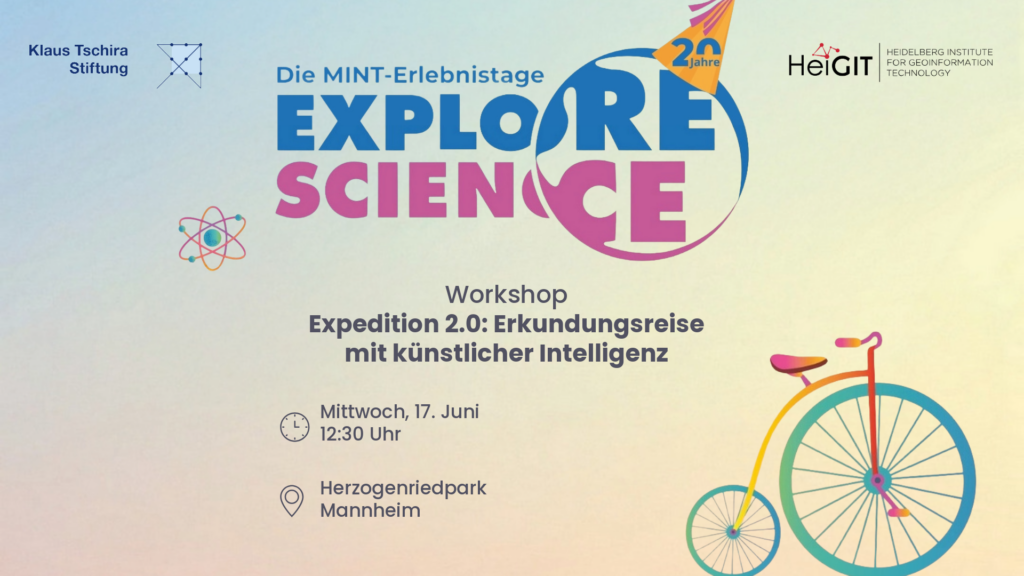
Since 2006, the Klaus Tschira Foundation has organized the annual STEM Experience Days “Explore Science” in Mannheim. Its central aim is to give children and young people the opportunity to discover scientific phenomena for themselves. With Explore Science, the Klaus Tschira Foundation wants to spark young people’s interest in scientific topics and promote networking between scientific institutions and schools.
This year, Explore Science is celebrating its 20th anniversary! From June 17 to 21, 2026, everything will revolve around the theme of inventions and discoveries. Curiosity is the driving force behind progress — it leads to discoveries that change our world and to inventions that open up new possibilities. This year’s focus is on the spirit of research behind great ideas: How do inventions come about? What coincidences or experiments lead to groundbreaking discoveries? And how do they shape our lives today and in the future?
Since 2018, the Klaus Tschira Foundation has also implemented this concept in Bremen, since 2022 at Lake Constance, and since 2025 in Magdeburg. The program for kindergarten children, school classes, and families ranges from interactive exhibitions and numerous hands-on stations to workshops, stage shows, and competitions.
Workshop: Expedition 2.0: Journey of Exploration with Artificial Intelligence
Wednesday, June 17: 12:30 p.m.
Speakers: Levi Szamek, Elena Mercantini
What do world maps, artificial intelligence, and faraway places have in common? In this workshop, you will become 21st-century explorers! In the past, people sailed across the seas to fill in blank spots on the map. Today, we do this from the workshop tent—with images and AI. Together, we will apply computer vision and use it to analyze image data from regions in Madagascar that have so far been little documented and that probably none of you have ever seen. You will learn how to mark objects in photos, such as houses or utility poles, and use them to train an AI model that can later recognize these objects on its own. You will experience firsthand how machines see, why they sometimes get things wrong, and what role light, movement, or context plays in this. At the end, we will discuss the results and present a digital map containing the information you created yourselves. Afterwards, we will show you how aid organizations use this data to help people locally.