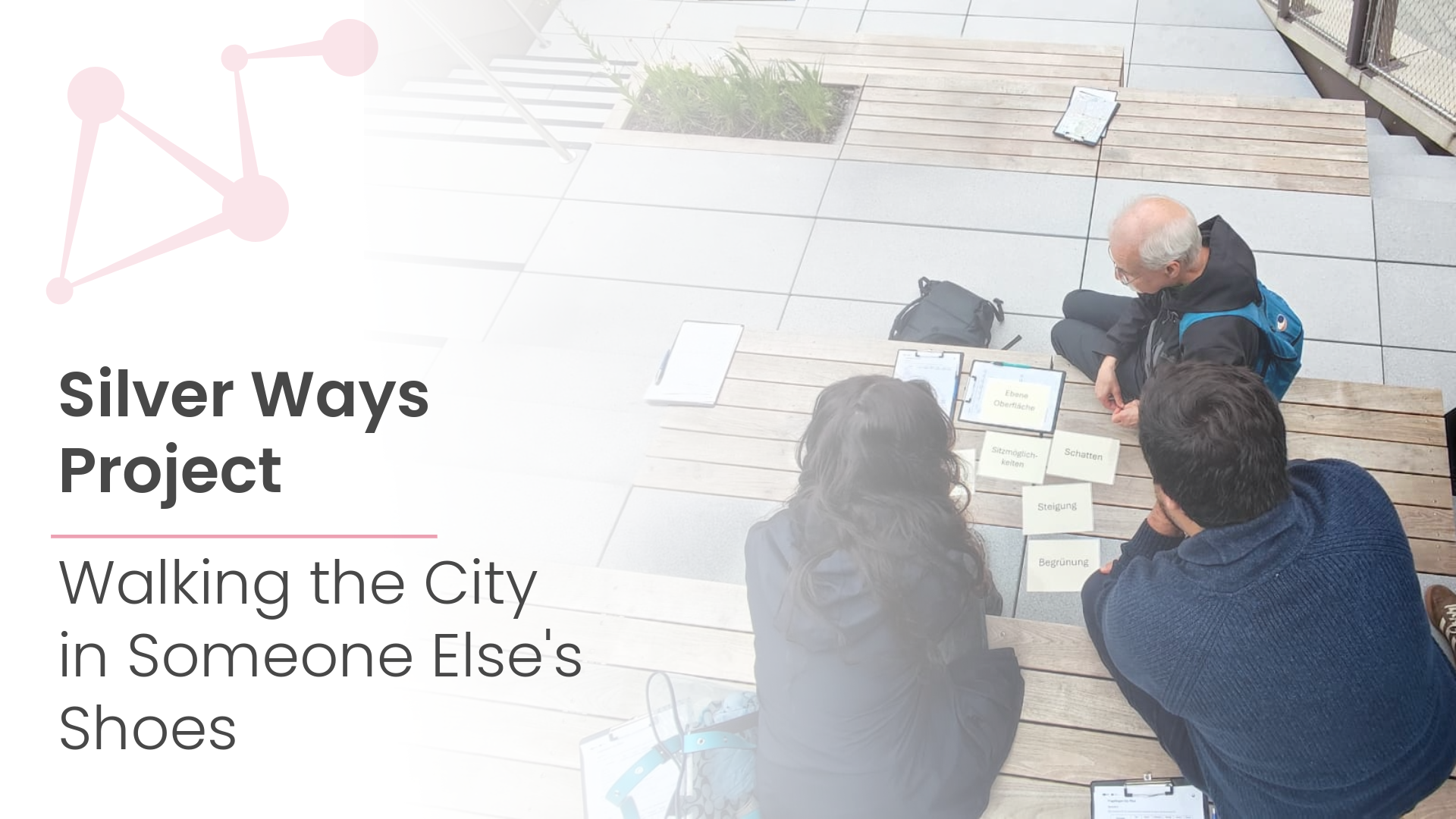
We left the office to experience the city through the eyes of older adults. But before we get into that, let us take a step back and explain why.
The Silver Ways project aims to improve mobility for older adults and people with age-related health conditions by developing a routing system tailored to their needs. Using the Silver 15-Minute Neighborhood Index, it evaluates how well older adults can reach essential services on foot, and works with municipalities in three cities across Germany, Sweden, and Turkey to co-design solutions that support independent mobility in later life.
Workshop “How does it feel to walk the city as an elderly person?”
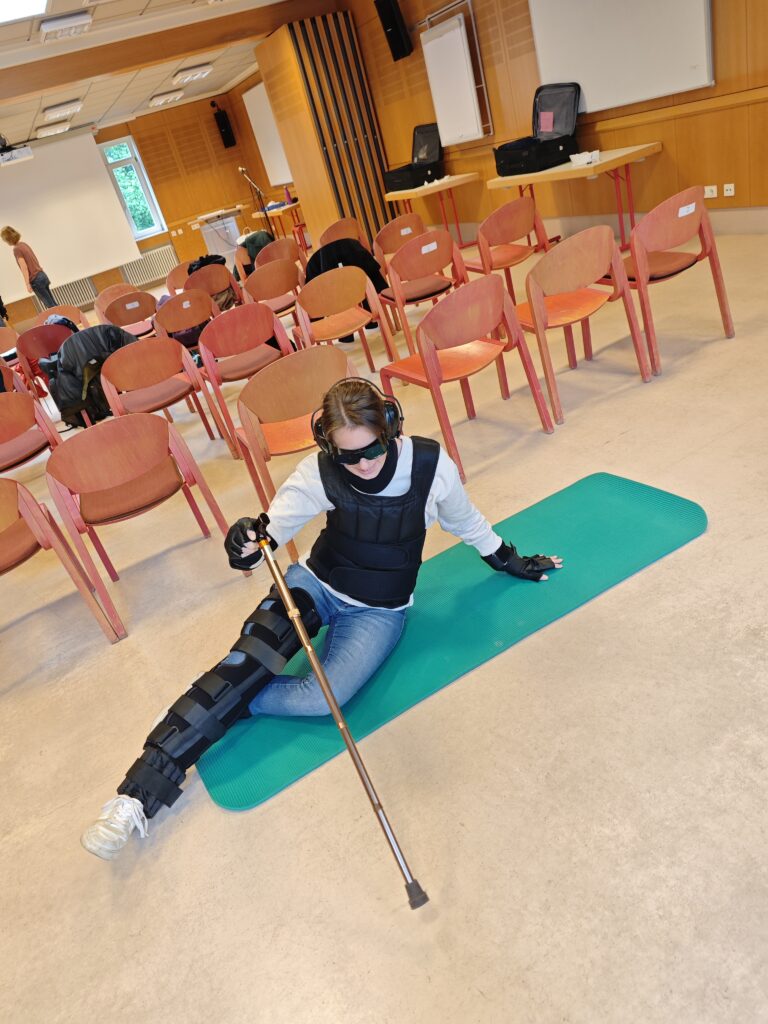
To get a first-hand experience of what is at stake, we teamed up with the Geriatric Center at Heidelberg University Hospital to explore the physical and sensory challenges older adults face in urban environments, wearing Age Simulation Suits.
After a short introductory lecture, we split into pairs and took turns wearing the suits. The person not in the suit acted as a companion and support, while the participant wearing it was asked to complete a series of tasks that would typically be unremarkable for an adult without mobility or sensory limitations. Each suit added around 18 kilograms of distributed weight to the body, combined with a knee brace that restricted natural movement, glasses simulating various forms of visual impairment, and headphones replicating hearing loss. Putting on each element one by one, you could feel the cumulative burden settling in before you had even taken a step.
Leaving the room already felt like a difficult task. Following a conversation was nearly impossible unless the other person stood directly in front of you and spoke slowly and clearly. The greatest challenge for almost everyone, though, was navigating a staircase, some even opted for the lift on the way back. People who are fit and physically active in their daily lives found themselves out of breath after walking just 100 meters.
Back in the meeting room, we took time to share our experiences and reflect on how the simulation had shifted our perception of the built environment.
“It is incredible how fast one feels isolated. Once you no longer hear or see well, the outside world starts to fade and one is left alone in their own mind,” says one of the participants.
We all agreed that our cities, in their current form, are largely designed for younger people without mobility or sensory limitations, and that gap is something the Silver Ways project is working directly to address.
Pilot Urban Living Lab workshop in Heidelberg
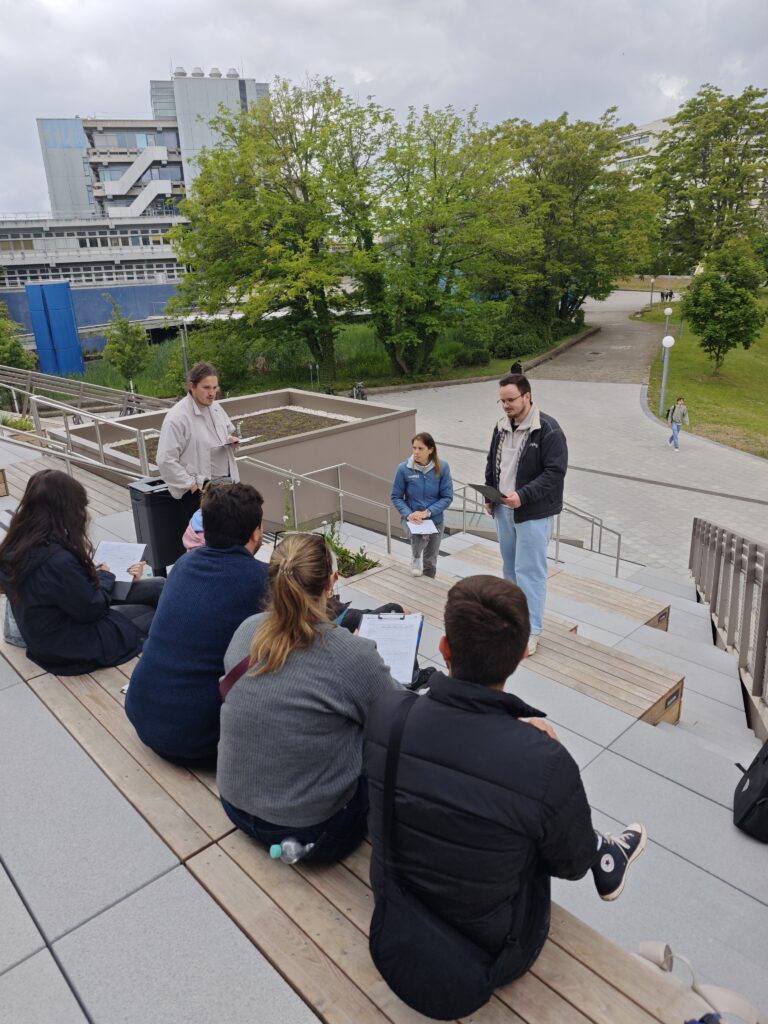
Simulating what it feels like to age is one thing; walking through a neighborhood and evaluating it through that lens is another. A few weeks later we organized a Pilot Urban Living Lab workshop in Heidelberg — a structured walk through the city designed to observe and assess the everyday built environment from the perspective of older adults. A small group of participants set out on a short route, paying close attention to details that are easy to overlook when you move through a space without difficulty.
The group assessed a range of indicators along the way: the condition and width of sidewalks, the quality of surface materials underfoot, the availability and spacing of benches for rest, the presence of shade trees and greenery, and exposure to direct sunlight. Each element was observed, discussed, and then weighted by the group.
“You stop seeing the street as a backdrop and start seeing it as a series of decisions the city has already made for you, and not always in your favor,” one participant observed after the walk.
The same walk was conducted in parallel in all Silver Ways partner cities using the same framework and indicators. The goal was to test the concept across different urban contexts, identify what needed to be adapted to local conditions, and build a shared methodology that the project can use as it moves into deeper co-design work with municipalities.
The insights gathered will directly inform the series of walks we are planning with elderly residents in September. Crucially, the routes for those walks will be based on travel diaries created together with older adults from several neighborhoods in Mannheim and in partner cities earlier this year. Participants will evaluate the streets they use, and their observations will then feed into a routing system built specifically for older adults. That system is validated and refined through these kinds of urban living lab walks, closing the loop between lived experience and technical design.
Both workshops proved yet again that understanding how older adults move through a city cannot be reduced to research alone. It requires slowing down, paying attention, and, if needed, walking in someone else’s shoes.