The COVID-19 pandemic caused severe public health issues globally, with incidence rates differing spatially between and within countries. While various studies have analyzed socio-economic indicators on incidence, most focused on early pandemic waves or used non-spatial models. This study, presented at AGILE 2026, addresses this gap by quantifying the effect of five socio-economic predictors on COVID-19 incidence rates across all German districts over the entire pandemic phase until April 2022. The research question centers on how spatial autocorrelation influences these relationships and whether regression coefficients vary spatially across the region.
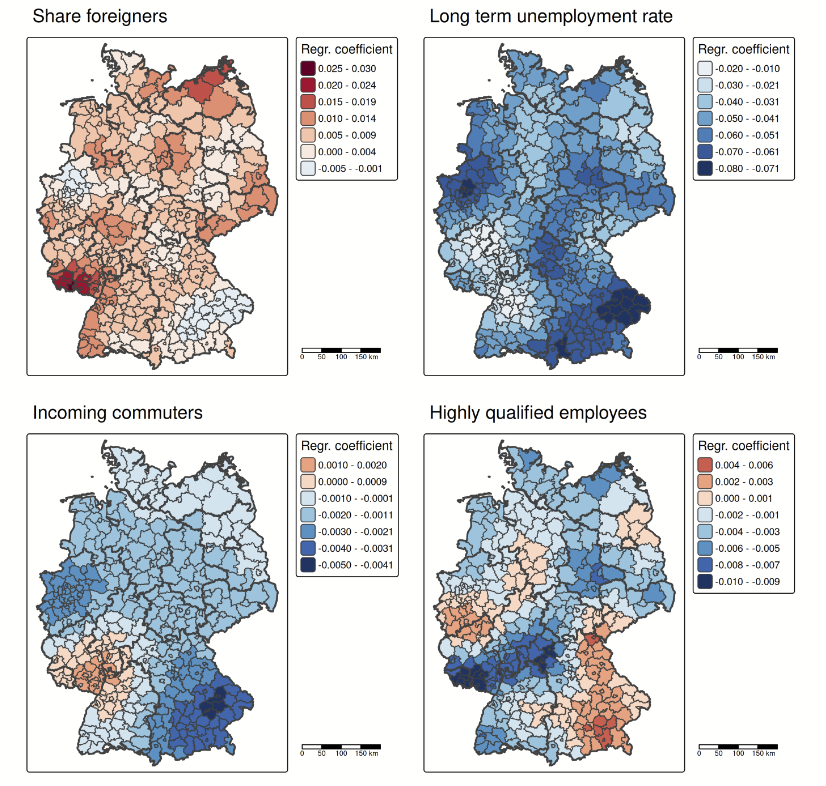
Data from the Robert-Koch-Institut (RKI) and 2017 baseline indicators from the Federal Institute for Research on Building, Urban Affairs and Spatial Development (BBSR) were used. Global Moran’s I identified significant spatial autocorrelation in incidence rates, especially during periods of increasing incidence rate. A quasi-Poisson generalized linear model with spatial eigenvector mapping accounted for positive spatial autocorrelation in regression residuals. Regression results indicated that four of five socio-economic predictors showed significant interactions with spatial eigenvectors, leading to spatially varying coefficients. Notably, the share of votes for the right-winged populist party showed a consistent positive effect, while long-term unemployment and incoming commuters exhibited negative associations in most regions, with exceptions in specific economic hubs.
The results suggest that the relationship between socio-economic predictors and incidence rates is moderated by additional local factors, likely reflecting sub-national politics or regional economic geography. However, the study acknowledges limitations regarding the modifiable area unit problem and the use of baseline socio-economic data from 2017. The inclusion of neighboring country information was omitted due to reporting differences. In conclusion, the analysis demonstrates that socio-economic variables have effects that vary spatially. This indicates that local factors must be considered for future public health interventions, as general national trends may not apply uniformly across all districts during a pandemic. Specifically, measures taken at the district level should be investigated further, to better understand how these influenced the incidence rate.
Reference: Lautenbach, S., Maurer, M., & Zipf, A. (2026). Analysis of the spatial and temporal pattern of COVID-19 incidence rate across Germany. AGILE GIScience Series, 7, 9. https://doi.org/10.5194/agile-giss-7-9-2026